
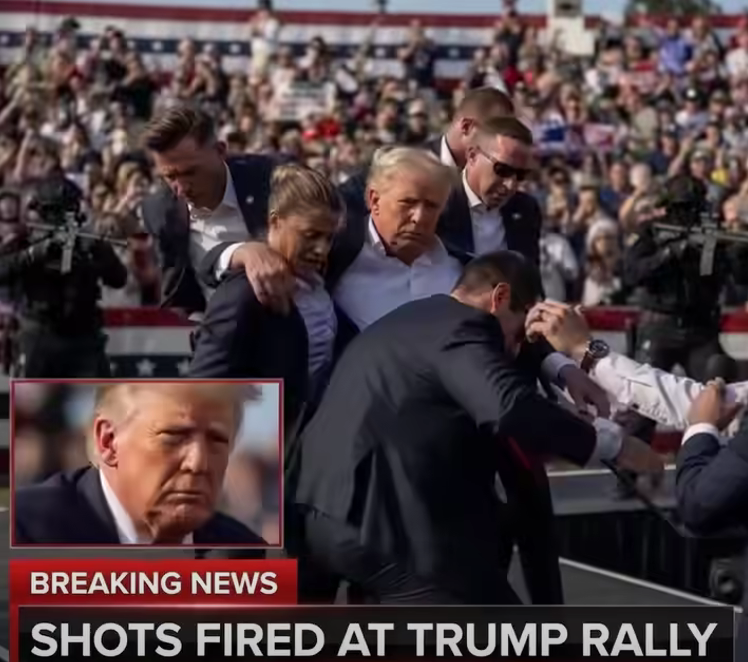
President Trump, first lady Melania and a slew of top lawmakers and White House officials had to be dramatically evacuated from the White House Correspondents Dinner Saturday night after a crazed gunman rushed the security perimeter and opened fire outside the ballroom.
The shooting erupted just after 8:30 p.m., about 20 minutes after the president and first lady made their grand entrance into the Washington Hilton ballroom in Washington, DC., where Trump and countless VIPS were set to toast the Washington press corps.
The shooter — blasted by Trump as a “sick” individual — charged toward the ballroom armed with a shotgun and multiple knives before being swiftly taken down by Secret Service agents in the lobby, police said, sharing shocking photos of the shirtless madman pinned face down on the floor.
Suspected Gunman Captured After Shooting Incident at White House Correspondents’ Dinner
A dramatic security incident unfolded during the annual White House Correspondents’ Association Dinner in Washington, D.C., when a suspected gunman allegedly attempted to approach the area where President Donald Trump was attending the event. According to law enforcement sources, the suspect was identified as Cole Allen, 31, a teacher and graduate of the California Institute of Technology (Caltech) from Torrance, California.
The shooting caused panic and confusion at one of the most high-profile political and media gatherings in the United States. The event, often referred to as the “nerd prom” because of its combination of journalists, politicians, celebrities, and public figures, was being held at a Washington hotel when the incident occurred.
Authorities quickly responded to the threat, and the suspect was taken into custody after reportedly rushing through a security checkpoint. Officials later stated that he was intercepted before reaching the ballroom where President Trump and hundreds of guests were gathered.
Speaking to reporters after the incident, President Trump confirmed that the suspect had been apprehended and praised the swift response of security personnel and law enforcement officers.
“The man has been captured,” Trump said. “They’re going to his apartment. I guess he lives in California, and he’s a sick person.”
The president’s comments came during a White House press briefing held shortly after the situation had been brought under control. Trump emphasized that the immediate danger had passed and expressed confidence in the ongoing investigation.
Authorities indicated that investigators were examining the suspect’s background, personal history, and possible motives. While many questions remained unanswered, officials stressed that preliminary evidence suggested the incident was carried out by a lone individual rather than as part of a broader conspiracy.
Interim Washington, D.C., Police Chief Jeffrey Carroll addressed the media and reassured the public that there was no continuing threat.
“At this point it does appear he is a lone actor, a lone gunman,” Carroll stated. “There does not appear to be any sort of danger to the public.”
The statement helped calm concerns that additional suspects might be involved or that further attacks could occur elsewhere in the city.
According to officials, the suspect was believed to have been a guest at the hotel where the event was taking place. Investigators are reportedly reviewing security footage, witness statements, and hotel records to determine exactly how he managed to get close to a highly secured area.
The White House Correspondents’ Dinner is traditionally protected by extensive security measures due to the presence of senior government officials, members of Congress, journalists, diplomats, and other prominent guests. The event is considered one of Washington’s most significant annual gatherings, making any security breach a matter of serious concern.
Witnesses described scenes of confusion and fear as security personnel rushed to respond. Guests reportedly ducked for cover while Secret Service agents and police officers moved rapidly to secure the venue.
One of the most concerning developments during the incident was the injury sustained by a Secret Service agent. According to President Trump, the agent was shot from close range with what he described as a “very powerful gun.”
Despite the seriousness of the attack, the agent survived thanks to the protection provided by a bulletproof vest. Trump later informed reporters that the agent was recovering in a local hospital and was expected to make a full recovery.
“He’s in great shape,” the president said, expressing gratitude for the protective equipment and the medical care the agent received.
The bravery of law enforcement and security personnel became a major focus of discussion following the incident. Trump repeatedly praised the Secret Service and local police officers for their quick reactions and professionalism under pressure.
“They did a fantastic job,” he said. “They acted very quickly.”
Security experts also noted that the successful interception of the suspect demonstrated the effectiveness of emergency response procedures designed for high-risk events involving national leaders.
The White House Correspondents’ Dinner has long been viewed as a unique event in American public life. Traditionally, it serves as an opportunity for politicians and journalists—who often disagree and criticize one another—to gather in a more relaxed setting. The evening typically includes speeches, humor, and reflections on the role of a free press in a democratic society.
This year’s event, however, took a dramatically different turn.
Trump reflected on the atmosphere in the room during and after the incident, saying that the crisis unexpectedly created a sense of unity among attendees.
“This was an event dedicated to freedom of speech that was supposed to bring together members of both parties with members of the press,” Trump said. “And in a certain way it did, because the fact that they just unified.”
The president described witnessing a rare moment in which political divisions seemed to disappear in the face of a shared emergency.
“I saw a room that was just totally unified,” he continued. “It was, in one way, very beautiful, a very beautiful thing to see.”
His comments highlighted the emotional impact the incident had on those present. Witnesses reported that people from different political backgrounds and professions worked together, helped one another, and followed instructions from security officials during the evacuation and lockdown procedures.
Initially, organizers indicated that they hoped the event could continue despite the disruption. Some believed that proceeding with the dinner would demonstrate resilience and send a message that violence would not succeed in interrupting democratic traditions.
However, as more information emerged about the shooting and security concerns continued, organizers ultimately decided to cancel the remainder of the evening’s program.
By approximately 9:45 p.m., officials announced that the event would not continue as planned.
The cancellation disappointed many attendees who had gathered for the annual occasion, but organizers emphasized that safety remained their highest priority.
President Trump later revealed that he had hoped the event could continue and said he had argued strongly in favor of completing the program.
According to Trump, he was prepared to deliver remarks that would have included criticism of the media and reflections on current political issues. However, he acknowledged that the circumstances made cancellation unavoidable.
The president also announced that organizers intended to reschedule the event within the next 30 days, allowing participants another opportunity to gather once security concerns had been fully addressed.
The incident immediately sparked a broader conversation about political violence and security in the United States. Analysts pointed out that threats against public officials have increased in recent years, placing additional pressure on security agencies responsible for protecting elected leaders and major public events.
Experts noted that high-profile gatherings such as the White House Correspondents’ Dinner present unique challenges because they bring together hundreds of influential individuals in a single location. Maintaining security while preserving accessibility and openness requires extensive planning and coordination among multiple agencies.
In the aftermath of the shooting, investigators began examining how the suspect was able to approach the security perimeter. Questions were raised about whether additional precautions could have prevented the incident or detected the threat earlier.
Federal authorities, local police, and Secret Service officials are expected to conduct a comprehensive review of the event. Such reviews typically analyze every aspect of the response, including communication systems, crowd management, access control, and emergency procedures.
Meanwhile, attention has also turned to the suspect himself. Investigators are reportedly gathering information about his personal history, professional background, and recent activities. Law enforcement agencies often examine digital communications, social media accounts, travel records, and other evidence in an effort to understand the motives behind attacks of this nature.
As the investigation continues, officials have urged the public not to speculate and to allow authorities time to collect and verify the facts.
The shooting has already become one of the most significant security incidents associated with the White House Correspondents’ Dinner in recent memory. While the event is known for political commentary and media attention, it is rarely associated with acts of violence.
For many attendees, the evening will be remembered not for speeches or headlines but for the frightening moments when an ordinary gathering was suddenly transformed into a scene of emergency.
Despite the shock and disruption, authorities emphasized that the outcome could have been far worse. The suspect was apprehended, the president remained unharmed, and the injured Secret Service agent survived. Officials credited these outcomes to the rapid actions of security personnel and first responders.
As Washington and the nation continue to process the incident, investigators remain focused on determining exactly what happened and why. Their findings will likely influence future security protocols for major political and media events across the country.
For now, law enforcement officials maintain that the threat has been contained, the suspect is in custody, and there is no ongoing danger to the public. The investigation remains active, and additional details are expected to emerge as authorities continue their work.



Leave a Reply