
Grainy. Slightly shaky. No music. No filters. No dramatic soundtrack rising in the background. No perfectly positioned camera. No carefully planned scene.
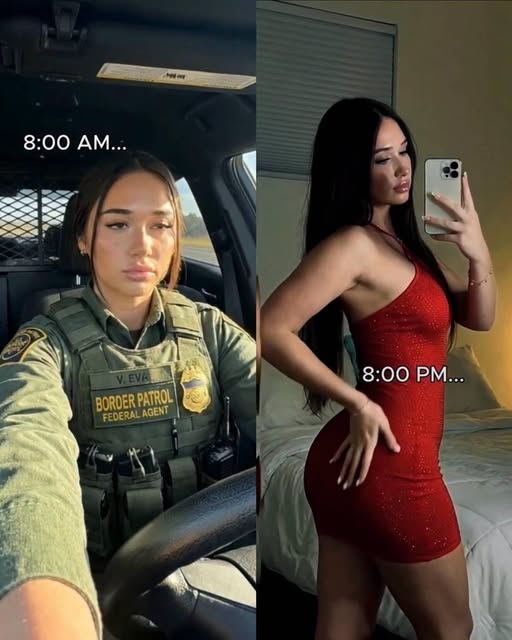
Just a young policewoman in uniform, standing beside her patrol car beneath the dim orange glow of a streetlight after what was clearly a long, exhausting shift.
The road around her is almost completely empty.
It is late at night, the kind of late when most windows are dark and most people have already gone home, closed their doors, and settled into bed without giving much thought to the people who are still awake outside.
She is one of those people.
For hours, she has been moving through the city while everyone else sleeps.
Now she is standing still.
Her patrol car is parked along the side of the road, its familiar shape barely visible in the darkness. The streetlight above her creates a small circle of light on the pavement, while everything beyond it disappears into deep shadows.
The camera is not stable.
It moves slightly from side to side, occasionally becoming blurry before finding focus again. The image has visible grain, the kind of natural imperfections that make the footage feel like something captured in a real moment rather than something created for a camera.
There is no music.
Only the distant sound of traffic.
A faint breeze.
The quiet hum of the city.
And occasionally, the soft crackle of the police radio inside the vehicle.
She doesn’t say anything.
She doesn’t need to.
Her face tells the story.
She looks exhausted.
Not in an exaggerated way, but in a way that anyone who has worked a long shift can recognize. Her eyes are heavy. Her expression is calm but drained. Her shoulders have relaxed slightly, as if she has finally reached the point where she can let some of the tension leave her body.
For most of the night, she probably couldn’t afford to look tired.
She had to stay alert.
She had to listen.
She had to make decisions.
She had to respond when people called for help.
She had to remain calm in situations where other people were frightened, angry, confused, or overwhelmed.
But now, standing alone beside her patrol car, there is no immediate emergency.
For a few minutes, she can simply be herself.
She looks toward the road.
The street stretches ahead of her, almost completely empty. A traffic light changes in the distance even though there are barely any cars around to see it.
She takes a slow breath.
Then another.
The kind of breath someone takes when they have finally realized that the hardest part of the night may be over.
Her hands rest naturally near the front of her uniform. Her posture is still professional, but there is a noticeable tiredness in the way she stands.
The uniform that looked sharp at the beginning of the shift now looks like something she has been wearing for far too many hours.
There are small signs of fatigue everywhere.
Her hair is slightly out of place.
Her expression has lost the energy it probably had earlier.
Her movements are slower.
Yet she remains composed.
The patrol car beside her is covered in faint reflections from the streetlight. The windshield reflects the darkness above, while the side of the vehicle catches the warm light from the lamp.
Inside the car, the radio remains ready.
There may be paperwork waiting.
There may be reports that still need to be completed.
There may be another call at any moment.
That is the difficult part of the job.
Even when everything is quiet, you never know how long the quiet will last.
She glances toward the patrol car.
Maybe she is wondering whether she can finally go home.
Maybe she is thinking about the last call she answered.
Maybe she is replaying something that happened earlier in the evening.
Maybe she is thinking about someone she loves waiting for her to return.
Or maybe she isn’t thinking about anything at all.
Maybe she is simply tired.
Sometimes exhaustion becomes so overwhelming that the mind stops trying to process everything.
There is only the desire to sit down.
Take off the uniform.
Put the keys somewhere.
Drink some water.
Go home.
Sleep.
And wake up knowing that the world kept moving while she was away.
The camera slowly moves closer.
Still shaky.
Still imperfect.
Still completely unfiltered.
The closer view reveals more details of her expression. She looks young, but the night has clearly taken something out of her.
She looks down at the pavement.
For a few seconds, she doesn’t move.
Then she looks up again.
There is something quietly emotional about the moment.
Not because something dramatic is happening.
But because nothing is happening.
That is what makes it feel real.
There are no flashing lights.
No chase.
No dramatic arrest.
No crowd watching.
No reporters.
No one applauding.
Just a person at the end of a difficult day.
A person whose work often becomes invisible the moment the emergency is over.
Earlier, she may have helped someone through the worst moment of their life.
She may have arrived when everyone else was afraid.
She may have been the person someone called because they didn’t know who else to call.
She may have spent hours dealing with situations that she will never talk about publicly.
And now, after everything is finished, she stands alone under a streetlight.
The city doesn’t know her name.
Most people passing through this neighborhood would probably never notice her.
They would simply see a patrol car and continue driving.
But there she is.
Still standing.
Still working.
Still carrying the responsibility that came with putting on that uniform.
A car passes in the distance.
Its headlights briefly illuminate the road before disappearing.
She watches it for a moment.
Then the street becomes quiet again.
The radio inside the patrol car suddenly makes a faint sound.
She turns her head.
For a second, the tiredness disappears from her expression.
Her attention immediately returns.
That is the instinct of someone who has spent hours on duty.
Even exhaustion cannot completely turn off the awareness.
She listens.
The radio becomes quiet again.
Nothing urgent.
She exhales.
Another moment passes.
She looks at her watch.
The shift has gone on longer than expected.
Perhaps she was supposed to finish hours ago.
But emergencies don’t follow schedules.
People don’t get into trouble according to a timetable.
And sometimes a shift that should have ended earlier simply keeps going.
She reaches toward the driver’s door.
Her hand rests on the handle.
But she doesn’t open it immediately.
Instead, she pauses and looks down the street one more time.
There is something almost peaceful about the darkness now.
The same streets that were busy earlier are empty.
The buildings are silent.
The windows are dark.
The city is resting.
And she is finally preparing to leave.
She opens the door.
The interior light comes on.
For a moment, the warm glow from inside the patrol car illuminates her face.
She looks even more tired now.
She sits down behind the wheel.
The door remains open for a few seconds.
She leans back.
Closes her eyes.
Just for a moment.
It is not sleep.
It is simply a brief pause.
A tiny moment of silence before she starts the final part of her night.
Then she opens her eyes.
Reaches for the keys.
The engine starts.
The sound of the vehicle breaks the silence.
The headlights turn on and stretch across the empty road.
She adjusts her seat.
Checks the mirrors.
Looks ahead.
Professional again.
Ready again.
Even after hours of exhaustion, she knows she still has to drive safely home.
The camera remains outside.
The patrol car is still underneath the streetlight.
For a few seconds, nothing happens.
Then the vehicle begins to move.
Slowly.
Almost reluctantly.
The tires roll over the pavement.
The patrol car passes through the circle of light and enters the darkness.
Its headlights become smaller as it moves farther down the road.
The camera stays in place.
The sound of the engine becomes quieter.
The red and blue markings on the vehicle are barely visible now.
Then the patrol car turns at the end of the street.
The headlights disappear.
And suddenly, the road is empty again.
The streetlight continues to glow.
Nothing else changes.
No music starts.
No words appear.
No dramatic ending is necessary.
Because the moment already says enough.
There are thousands of people who work while others sleep.
People who drive through empty streets.
People who answer phones at impossible hours.
People who respond to emergencies.
People who remain awake when everyone else is resting.
And sometimes, their most human moments happen when nobody is watching.
A few minutes beside a patrol car.
A tired breath.
A glance at an empty road.
A quiet realization that the shift is finally over.
The young policewoman may go home tonight and fall asleep almost immediately.
She may wake up tomorrow and do it all again.
Another uniform.
Another patrol car.
Another long night.
Another series of calls.
Another set of people who need help.
And she may never know how many people noticed the work she did.
That is the strange thing about certain jobs.
The moments that matter most are often the moments that receive the least attention.
When everything goes well, nobody remembers who was there.
When an emergency ends safely, people simply go home.
When a frightened person finally feels safe, they may never think about the person who helped make that possible.
But someone was there.
Someone stayed.
Someone answered the call.
Someone drove through the darkness.
Someone stood beneath a streetlight long after most of the city had gone to sleep.
And tonight, that person was her.
The camera remains fixed on the empty road.
The grainy image shakes slightly in the wind.
The streetlight hums softly overhead.
In the distance, a few lights remain visible.
The city is beginning to approach morning, even if dawn is still far away.
Another night is slowly becoming another memory.
The patrol car is gone.
The officer is gone.
But the quiet scene remains.
A simple reminder that behind every uniform is a human being.
Someone who gets tired.
Someone who worries.
Someone who misses home.
Someone who has difficult days.
Someone who sometimes just needs a few quiet minutes to breathe.
Yet despite all of that, she showed up.
She stayed.
She worked.
And when the night finally allowed her to leave, she got back into her patrol car and drove home.
No applause.
No recognition.
No perfect ending.
Just a tired young woman, an empty road, a dim streetlight, and the quiet dignity of someone who had spent the night doing a job that demanded everything from her.
The camera slowly loses focus.
The streetlight becomes a soft blur.
The grain becomes more noticeable.
The road remains silent.
And somewhere beyond the darkness, another ordinary morning is waiting.
For everyone else, it will simply be another day.
For her, it will be the beginning of another shift, another responsibility, another opportunity to help someone who may need her.
But for tonight, at least, the patrol car is finally heading home.
And the street is quiet.









Leave a Reply