
Russia launched another wave of drone and missile strikes across Ukraine overnight, targeting multiple regions as the war continues to intensify. According to Ukrainian officials, the attacks caused significant damage to civilian infrastructure, including residential buildings, power facilities, and public infrastructure. Air raid sirens sounded in several cities as Ukrainian air defense systems attempted to intercept incoming drones and missiles.
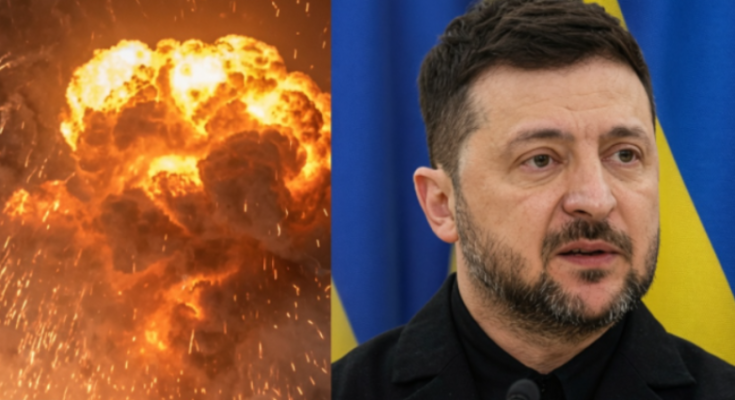
Emergency officials reported explosions in multiple urban areas, prompting firefighters, rescue crews, and medical teams to respond to damaged sites. Authorities said they worked through the night to extinguish fires, assist injured civilians, and assess the extent of the destruction. Residents in affected regions were urged to remain in shelters and follow official safety instructions amid concerns that additional strikes could follow.
At the same time, unverified claims have circulated widely on social media and other unofficial platforms alleging that a Russian strike hit a secure location in Ukraine and killed President Volodymyr Zelenskyy. Some posts also claim that Ukrainian media outlets are reporting the incident.
As of this writing, there is no official confirmation from the Ukrainian government that President Zelenskyy has been killed. Likewise, no credible international news organizations have verified the claim. In conflict situations, false or misleading reports often spread rapidly online, particularly regarding high-profile political leaders and major military developments.
Military analysts and independent observers continue to urge caution when evaluating such claims, noting that misinformation is a frequent feature of modern warfare. Until Ukrainian authorities or multiple reliable independent news organizations confirm the information, reports alleging the death of President Volodymyr Zelenskyy should be regarded as unverified and should not be presented as established fact.
Zelenskyy Death Claims Remain Unverified as Questions Grow Online
The uncertainty surrounding the reports has continued to fuel speculation across social media, with thousands of users discussing the alleged strike and attempting to determine whether the claims are genuine. Some accounts have presented the allegations with increasing certainty, while others have questioned the lack of evidence and urged people not to share information that has not been independently confirmed.
The rapid spread of the claims has also created confusion among people following developments from outside Ukraine. In the absence of clear confirmation, individual posts, screenshots, short video clips, and anonymous statements can easily be interpreted as evidence even when their original source cannot be established.
Some social media users have pointed to reports of explosions and damage in Ukrainian cities as possible evidence supporting the allegation. However, the occurrence of explosions does not by itself establish that President Zelenskyy was present at any of the affected locations. Without reliable information identifying the target, the people who may have been inside, and the circumstances surrounding the incident, such connections remain speculative.
The same caution applies to claims that Ukrainian media outlets have already confirmed the president’s death. Screenshots circulating online may not accurately represent what an outlet actually published, and older articles or manipulated images can sometimes be presented as breaking news. Readers should therefore verify such claims by checking the original publication and looking for confirmation from established news organizations.
The situation is particularly sensitive because information surrounding military strikes can remain incomplete for hours. Emergency crews may still be working at damaged locations, authorities may be assessing casualties, and security concerns can prevent officials from immediately releasing details about sensitive sites.
That uncertainty can create an environment in which rumors develop quickly.
A single unverified claim can be copied by dozens of accounts, then repeated by hundreds more. Eventually, the number of posts discussing the allegation can give the impression that the information has been independently confirmed, even when every post can be traced back to the same original source.
This phenomenon has become increasingly common during major conflicts.
The speed of modern social media means that information can travel across borders almost instantly. A claim originating from an anonymous account can reach international audiences before journalists have had an opportunity to establish whether the information is authentic. Once a dramatic story begins trending, correcting it can become considerably more difficult than spreading it in the first place.
For that reason, experts generally recommend looking beyond the number of people repeating a claim and instead examining the quality of the evidence behind it.
In this case, the most important question remains whether credible authorities or multiple independent news organizations have confirmed that President Zelenskyy was killed. At present, the answer remains no.
That does not prove that every detail surrounding the reported strikes is known or that no further information will emerge. It simply means that the specific claim about Zelenskyy’s death has not been established through reliable evidence.
The distinction is important because reporting an unverified allegation as fact could create unnecessary panic, particularly in a country already experiencing the consequences of a prolonged war.
There is also a broader concern surrounding the potential impact of false reports about national leaders. Claims about the death or disappearance of a head of state can affect public confidence, financial markets, diplomatic relations, military decision-making, and the emotional state of civilians. Even when eventually proven false, such reports can have consequences long after they have been corrected.
This is why credible journalism generally requires a much higher standard of verification for extraordinary claims.
Major international news organizations typically seek confirmation through multiple channels before reporting the death of a sitting national leader. They may consult government officials, diplomatic sources, eyewitnesses, medical authorities, military officials, and independent reporters. The process can take time, particularly when the alleged incident occurs in a secure or restricted area.
Until such verification becomes available, uncertainty should remain clearly identified as uncertainty.
For people following the situation online, the safest approach is to avoid treating anonymous posts as established information. Users should be especially cautious when a post uses dramatic language, provides no identifiable source, relies on screenshots rather than original reporting, or claims that authorities are hiding information without providing evidence.
The continuing reports of explosions remain a serious matter regardless of the separate Zelenskyy allegation. Firefighters, rescue personnel, and medical workers continue to face dangerous conditions when responding to damaged areas, while civilians may be dealing with destroyed homes, injuries, fires, and disruption to daily life.
Authorities have continued to emphasize the importance of following official safety instructions. People in affected areas may be asked to remain in shelters, avoid certain roads or buildings, and stay away from locations where emergency operations are underway.
As the situation develops, additional information may become available. New statements from Ukrainian officials, verified reports from international journalists, or independently authenticated evidence could potentially clarify what happened and whether any senior Ukrainian officials were affected.
Until then, the distinction between confirmed information and online speculation remains critical.
The reports alleging that a Russian strike killed President Volodymyr Zelenskyy should therefore continue to be treated as unverified. The existence of widespread discussion, repeated social media posts, or claims that unnamed Ukrainian outlets have confirmed the story does not constitute independent verification.
In a rapidly changing conflict, waiting for reliable confirmation may feel frustrating, but it remains essential. Information can change as investigations progress, and responsible reporting requires acknowledging what is known, what is unknown, and what has not yet been established.
For now, the reported explosions and emergency response are developments that can be followed through official statements and credible reporting, while the claim regarding President Zelenskyy’s alleged death should remain firmly in the category of unconfirmed information unless reliable authorities and independent news organizations provide evidence establishing otherwise.










Leave a Reply