
The world did not stop when Bruce Willis stepped away from the camera.
There was no single moment when the lights of Hollywood went dark, no dramatic announcement capable of fully explaining what it meant to see one of the industry’s most recognizable faces gradually disappear from the screen. For decades, Willis had seemed almost permanent. He was there in action movies, thrillers, comedies, dramas, television appearances, interviews, red carpets and countless posters hanging on bedroom walls.
Then, slowly, he was no longer there.
At first, many people simply called it retirement.
It was an ordinary word for what felt like an extraordinary change.
Actors retire. Careers evolve. Movie stars decide to spend more time with their families. Hollywood is constantly replacing one generation of performers with another. To the outside world, the news could easily be understood as another chapter closing.
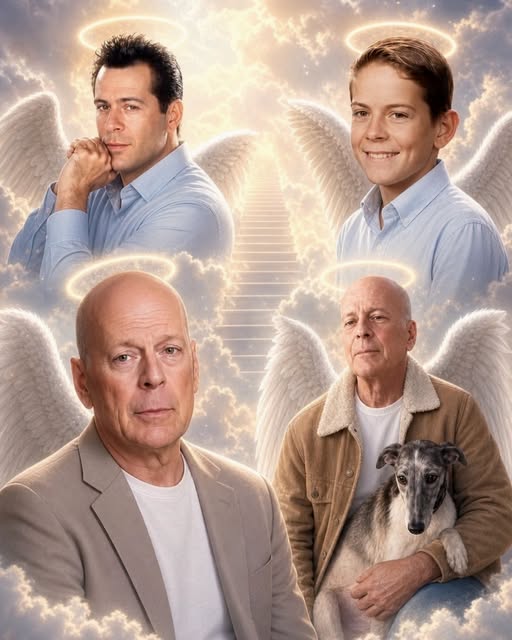
But behind that simple explanation was something much more painful.
Bruce Willis was living with frontotemporal dementia, commonly known as FTD, a neurological condition that can affect personality, behavior, language and communication. His family eventually made the diagnosis public after initially announcing that he had been diagnosed with aphasia, a condition that can interfere with a person’s ability to communicate.
For fans, the news changed the meaning of his retirement completely.
Suddenly, the absence of that familiar voice was no longer simply a professional decision.
It was a reminder of how quickly life can change.
For generations of moviegoers, Bruce Willis had represented a particular kind of screen hero. He was rarely the untouchable superhero who seemed completely fearless. His characters often looked tired, bruised, frustrated and vulnerable.
And that was precisely why audiences connected with him.
He could be tough without appearing invincible.
He could be funny without turning every scene into a joke.
He could look frightened and still keep moving forward.
Perhaps most importantly, he made ordinary people believe they could survive extraordinary circumstances.
That quality became one of the defining characteristics of his career.
When Willis appeared as John McClane in Die Hard, audiences were introduced to an action hero who felt different from many of the larger-than-life characters dominating the genre. McClane was not a perfect warrior. He was a police officer caught in a terrifying situation, a man who was exhausted, injured and frequently overwhelmed.
Yet he kept going.
That became part of the Bruce Willis mythology.
He kept going.
Through explosions.
Through impossible odds.
Through jokes made at the worst possible moments.
Through characters who were emotionally damaged but still searching for a way forward.
His performances helped turn him into one of the defining stars of his generation.
But there was another side to Willis that audiences sometimes forget when discussing his action roles.
He was also a comedian.
He had an ability to deliver a line with a dry expression and perfect timing. His television work helped establish that comedic identity long before many of his biggest films arrived. His role in Moonlighting demonstrated that he could carry a scene through personality alone, and that charisma later became an essential part of his movie career.
He could be serious.
He could be sarcastic.
He could be vulnerable.
He could be absurd.
And audiences believed him in all of those roles.
That versatility helped make his eventual absence feel so strange.
For years, seeing Bruce Willis on a screen was almost taken for granted.
There would always be another movie.
Another interview.
Another trailer.
Another character.
Another familiar voice.
Another sarcastic smile.
Then came the announcement that changed everything.
In March 2022, Willis’s family announced that he would be stepping away from acting after being diagnosed with aphasia. At the time, the statement explained that the condition was affecting his cognitive abilities.
The reaction from fans was immediate.
Messages of support flooded social media.
Actors and filmmakers who had worked with him shared memories.
People who had never met him personally spoke about how much his movies had meant to them.
But even then, many people did not fully understand what was happening.
They heard the word “retirement.”
They understood that he was facing a health problem.
But the deeper reality would become clearer later.
In February 2023, his family announced that his diagnosis had progressed to frontotemporal dementia.
The announcement was devastating because FTD is not simply a condition associated with getting older. It can profoundly affect behavior, language, personality and other cognitive functions.
The news transformed the public understanding of his earlier retirement.
What had looked like the ending of a Hollywood career was actually part of a much more personal journey.
And that is where the story becomes less about Hollywood and more about family.
Because behind every headline about Bruce Willis is a group of people who know him not as an action star, but as a husband, father, friend and loved one.
His family has repeatedly emphasized the importance of compassion, understanding and awareness surrounding dementia.
That message matters because conditions affecting the brain are often misunderstood.
People may see someone struggling to communicate and assume they are confused.
They may notice changes in behavior and not understand the underlying reason.
They may hear someone struggling to find a word and mistake it for ordinary forgetfulness.
But neurological conditions can be far more complicated than that.
FTD can affect different people in different ways, and its symptoms can be deeply challenging for both the individual and those around them.
For families, the experience can involve a gradual adjustment to a new reality.
The person they love is still there.
But certain abilities may change.
Certain conversations may become different.
Certain routines may need to be adapted.
And memories that once felt distant can suddenly become incredibly precious.
For fans, there is an entirely different kind of grief.
It is the strange experience of watching someone who meant so much to you become increasingly absent from the public world while knowing that the person themselves deserves privacy.
There is a temptation, especially in the age of social media, to expect constant updates from celebrities.
Fans want photographs.
They want videos.
They want reassurance.
They want to know how someone is doing.
But illness changes the boundaries of that relationship.
Bruce Willis spent decades entertaining millions of people.
That does not mean the public is entitled to every private moment of his life.
His family has the right to decide what is shared and what remains within the family.
That distinction has become especially important as his condition has progressed.
The internet can be incredibly compassionate, but it can also be intrusive.
A photograph can spread around the world in minutes.
A rumor can become a headline before anyone confirms whether it is true.
A private family moment can suddenly become content for millions of strangers.
For someone living with a neurological disease, that attention can be especially difficult.
This is why the story of Bruce Willis has also become part of a much larger conversation about dignity.
What does it mean to support a celebrity who is seriously ill?
Is it enough to say that we miss seeing them?
Or should we learn more about the condition they are living with?
Should we understand what their families are experiencing?
Should we respect their privacy even when our curiosity remains?
For many people, the answer has increasingly become clear.
Support does not have to mean access.
Sometimes support means allowing someone to live away from the spotlight.
And perhaps that is one of the most difficult things for fans to accept.
Bruce Willis spent much of his career giving audiences access to his talent.
He gave them characters to root for.
He gave them stories to remember.
He gave them moments that became part of popular culture.
But now, the most meaningful thing fans can give back may be respect.
The temptation to define Willis entirely through his illness should also be resisted.
FTD is part of his story, but it is not the whole story.
Before the diagnosis, there were decades of work.
There were performances that made people laugh.
There were movies that terrified audiences.
There were action sequences that became iconic.
There were dramatic scenes that stayed with viewers long after the credits rolled.
There were songs, interviews, friendships, collaborations and countless ordinary moments that never became headlines.
There was a life before the illness.
And that life matters.
For many fans, revisiting his movies has therefore become an emotional experience.
A scene from Die Hard may suddenly feel different.
A joke from The Whole Nine Yards may bring back a particular period of someone’s life.
A dramatic moment from The Sixth Sense may remind viewers why Willis was capable of much more than action roles.
A familiar expression can transport someone back decades.
That is one of the strange powers of cinema.
Actors can remain present in our lives even when they are no longer physically present in the same way.
Their performances do not age exactly as we do.
A movie made decades ago can be watched tonight by someone who was not even born when it was released.
The actor remains on screen.
The voice remains.
The character remains.
The moment remains.
In that sense, Bruce Willis never truly disappears.
The world may not get many new Bruce Willis movies.
But the old ones remain.
And they continue introducing him to new generations.
A teenager watching Die Hard today may experience the same charisma that audiences felt decades ago.
A family watching one of his comedies can still laugh at the same jokes.
Someone discovering his earlier work for the first time can still understand why he became such a major star.
That is the strange comfort of art.
It allows people to remain present through their work.
But there is another important lesson in Willis’s story.
It is a reminder that fame does not protect anyone from human vulnerability.
For years, Willis appeared almost indestructible.
His characters survived explosions, gunfights, car crashes, disasters and impossible situations.
Audiences became accustomed to watching him get beaten down and somehow stand back up.
Real life, however, does not follow the rules of an action movie.
There is no dramatic soundtrack that guarantees everything will be okay.
There is no final scene where the hero defeats the problem.
There are illnesses that cannot be punched away.
There are conditions that cannot be outrun.
There are moments when strength means something completely different from physical toughness.
Sometimes strength means accepting help.
Sometimes it means allowing family to care for you.
Sometimes it means stepping away from the thing you love.
And sometimes it means continuing to live as fully as possible within circumstances you never chose.
That may be the most profound contrast between Bruce Willis’s fictional characters and his real life.
On screen, he often fought until the final second.
Off screen, his greatest challenge has been something no movie hero could defeat with a weapon, a joke or a perfectly timed explosion.
His story is human.
And that is why it hurts.
For millions of people, Bruce Willis was never just another actor.
He was part of the background of their lives.
He was there during childhood movie nights.
He was there on television after school.
He was there during late-night movie marathons.
He was there in theaters with friends.
He was there during periods of happiness and periods when people needed an escape.
The audience changed.
The decades changed.
Hollywood changed.
But Bruce Willis remained familiar.
Until suddenly, he wasn’t.
The silence that followed his departure from acting therefore felt larger than the retirement of one performer.
It felt like the closing of a chapter.
A chapter in which certain movie stars seemed almost permanent.
A chapter before streaming completely transformed the entertainment industry.
A chapter when action movies became cultural events.
A chapter when a movie star’s face on a poster could be enough to make people buy a ticket.
And while that chapter may be over, its impact remains.
The world did not stop when Bruce Willis stepped away from the camera.
Hollywood continued.
New stars appeared.
New franchises were created.
New technologies changed filmmaking.
New audiences discovered different heroes.
But something did change.
A familiar voice became quieter.
A familiar face appeared less often.
And millions of people were reminded that even the biggest stars are human beings whose lives continue beyond the screen.
Perhaps that is why the most important part of Bruce Willis’s legacy is not any single movie.
It is the emotional connection he created with audiences.
He made people laugh.
He made people nervous.
He made people cheer.
He made people believe that an ordinary man could survive an extraordinary night.
And now, through the courage of his family and the continued love of his fans, his story has also helped raise awareness about a condition that affects countless families around the world.
That may be an unexpected final chapter for a career built on entertainment.
But perhaps it is an important one.
Because while audiences may miss the movies, what matters most is the person behind them.
Bruce Willis does not need to make another film to prove what he accomplished.
He already did that.
He does not need another blockbuster to secure his legacy.
His legacy is already there.
It lives in the movies.
It lives in the memories of the people who watched them.
It lives in the stories fans continue to tell.
And it lives in the countless people who still hear that unmistakable voice and immediately know who they are listening to.
The camera may have moved on.
Hollywood may have moved forward.
But Bruce Willis remains part of the story.
Not simply because he was a movie star, but because for generations of audiences, he became something much more personal:
A familiar face.
A familiar voice.
A reminder of another time.
And a performer whose work will continue to speak long after the spotlight has gone quiet.











Leave a Reply