
60-Year-Old Man Goes Viral After Helping a Homeless Woman Off the Streets
A touching video showing a 60-year-old man helping a woman who was reportedly experiencing homelessness has captured widespread attention online. The brief nighttime clip has been shared across social media, with many viewers praising the stranger for stopping when others might have continued driving.
In the footage, the woman appears to be lying on pieces of cardboard near a busy road. Cars pass only a short distance away as the older man approaches her carefully and checks whether she is responsive. He then bends down and attempts to help her move from the pavement.
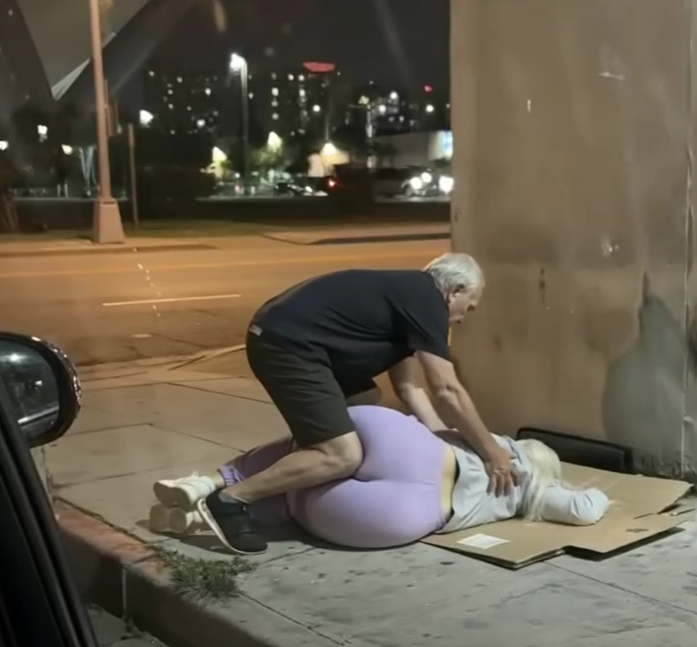
Posts accompanying the video claim that the man did more than offer assistance for a few minutes. According to those accounts, he contacted people who could provide the woman with food, clean clothing and a safe place to stay. Some versions of the story say he also helped connect her with a local shelter or outreach service so she would not have to spend another night on the street.
However, the names of the people involved, the location of the incident and the woman’s circumstances have not been independently confirmed. The complete story behind the video therefore remains unclear. Even so, the scene has started an important online conversation about homelessness and the way vulnerable people are treated in public spaces.
Thousands of social media users responded emotionally after seeing the man stop to help. Many said his actions were a reminder that compassion does not always require wealth or extraordinary resources. Sometimes it begins with noticing that another person is in distress, asking whether they are safe and contacting someone who can provide professional support.
Others emphasized that people should always act carefully when they encounter someone who appears to be unconscious, seriously injured, confused, or unable to move. Although the instinct to help can be immediate and powerful, the safest response is often to pause, assess the situation, and contact emergency services as quickly as possible. A person who is lying on the ground may be experiencing an injury or medical emergency that is not immediately visible, and attempting to move them without knowing what has happened could potentially make an unknown injury worse.
For that reason, members of the public are generally encouraged to call emergency services, describe what they can see, and follow the instructions given by trained professionals. If the person is in immediate danger from traffic, fire, extreme weather, violence, or another serious threat, moving them away from that danger may become necessary. Otherwise, it is usually safer to wait for emergency responders rather than attempting to lift or carry someone who may have suffered a serious injury.
When possible, trained medical personnel, paramedics, firefighters, police officers, or local outreach workers should be allowed to take over once they arrive. These professionals are equipped to assess a person’s condition, determine whether medical treatment is required, and connect vulnerable individuals with additional services when appropriate.
The situation becomes particularly complicated when the person involved is experiencing homelessness. A person sleeping on a sidewalk, in a doorway, in a park, or in another public place may be dealing with far more than what is visible to passersby. What appears to be a simple situation from a distance can sometimes be the result of years of financial difficulties, personal struggles, unstable housing, unemployment, family breakdown, disability, illness, addiction, or a combination of several circumstances.
Homelessness rarely has one single cause.
For some people, it begins with a sudden financial crisis. A job can disappear, rent can increase, or an unexpected expense can consume whatever savings a person has managed to build. Without a sufficient financial safety net, even a relatively small setback can quickly become a major crisis. Once someone loses stable housing, finding a new place to live can become considerably more difficult because many landlords require deposits, identification, proof of income, references, or a stable employment history.
For others, homelessness may follow the breakdown of a relationship or family support system. Someone who once had relatives or friends they could rely on may suddenly find themselves without anywhere to go. In other cases, people leave unsafe homes because remaining there would put them at risk. Domestic violence, family conflict, abuse, or other difficult circumstances can force people onto the streets even when they desperately want a safer and more stable life.
Health problems can also play a significant role.
Physical disabilities, chronic illnesses, mental health challenges, injuries, and other conditions can make it difficult for someone to maintain employment or navigate complicated housing systems. At the same time, living without stable housing can make existing health problems considerably harder to manage. Access to medication, regular meals, hygiene facilities, transportation, medical appointments, and a safe place to recover can all become major challenges.
People living on the streets may also face dangers that many members of the public rarely consider.
Extreme heat can turn pavement and enclosed spaces into dangerous environments. During cold weather, exposure can become life-threatening. Heavy rain can destroy the few belongings someone has. Strong winds can make temporary shelters unsafe. At night, people sleeping outside may be vulnerable to theft, assault, harassment, or other forms of violence.
Even something as simple as keeping personal documents safe can become difficult.
Identification cards, passports, birth certificates, medical records, bank cards, and other important documents can be lost, stolen, or damaged when a person has no secure place to store their belongings. Without identification, applying for housing, employment, benefits, healthcare, or other services can become significantly more complicated. This can create a frustrating cycle in which the absence of documentation makes it harder to obtain the very resources needed to escape homelessness.
Healthcare can present another major obstacle.
A person who has no permanent address may struggle to receive correspondence about appointments or applications. Transportation can also be expensive or unavailable. Someone experiencing homelessness may prioritize finding food, water, shelter, or a safe place to sleep over seeking treatment for a medical issue. Minor health problems can therefore become much more serious when they remain untreated.
This is why homelessness is not something that can always be solved through one isolated act of kindness.
A meal can help someone get through a difficult day. A bottle of water can provide relief during extreme heat. A blanket can provide temporary protection from the cold. A conversation can remind someone that they are still seen and valued. But long-term stability usually requires much more.
It can require access to affordable housing, healthcare, employment assistance, mental health support, substance-use services when needed, legal assistance, identification replacement, transportation, and consistent social support. Most importantly, it can require patience.
For someone who has spent months or years surviving from one day to the next, rebuilding a stable life may not happen overnight.
There may be paperwork to complete, appointments to attend, applications to submit, shelters to navigate, and countless obstacles along the way. A person may also have experienced so much disappointment or rejection that accepting help can initially feel difficult. Trust may take time to rebuild.
That is why compassionate outreach matters.
A person who stops to check whether someone is okay may never know what happens afterward. They may not witness the person being taken to a hospital, connected with a shelter, reunited with family, or introduced to an outreach organization. But their decision to stop can still matter.
Sometimes, the first step toward receiving help is simply someone noticing that help is needed.
A warm meal can become a conversation. A conversation can lead to a phone call. A phone call can connect someone with an outreach worker. An outreach worker can help locate temporary accommodation or healthcare. Temporary accommodation can eventually lead to more permanent housing and stability.
The chain may begin with something incredibly simple.
Someone chooses not to walk past.
That is one of the reasons moments like the one shown in the widely shared video can have such a powerful emotional effect on viewers. In a world where people often hurry past strangers while looking at their phones or focusing on their own responsibilities, seeing someone stop and show concern can feel unexpectedly meaningful.
The identity of the man involved has attracted attention, with viewers describing him as a hero because of the compassion displayed in the moment. Yet the larger message may be even more important than the identity of the person who intervened.
It is a reminder that vulnerable people are still people.
They have names, histories, families, memories, hopes, disappointments, and dreams. They may have once had homes, jobs, relationships, routines, and ordinary lives that looked completely different from what strangers see in a brief encounter.
A person sitting or lying on a sidewalk should not automatically be reduced to a label.
There may be an entire story behind how they reached that moment.
And while strangers cannot be expected to solve every problem they encounter, they can choose to respond with humanity.
That might mean calling emergency services when someone appears seriously unwell. It might mean contacting a local shelter or outreach organization. It might mean asking someone whether they are safe. It might mean offering food or water when appropriate. Or it might simply mean speaking to them respectfully rather than treating them as though they are invisible.
Small actions can carry surprising weight.
For someone who has spent days feeling ignored, being asked, “Are you okay?” can be meaningful. For someone who believes nobody notices them, a moment of genuine concern can provide a sense of dignity. And for someone facing an immediate crisis, a phone call to the right service could potentially become the beginning of a much larger change.
At the same time, experts and experienced outreach workers often stress the importance of boundaries and safety. Members of the public should not put themselves in danger or attempt medical procedures they are not trained to perform. Compassion does not require taking unnecessary risks.
The most helpful response is often a combination of humanity and caution.
If a person is unconscious, not responding, having difficulty breathing, bleeding heavily, experiencing a seizure, or otherwise appears to be facing a medical emergency, professional help should be contacted immediately. People should follow emergency-dispatch instructions and avoid unnecessary movement unless there is an immediate threat to the person’s safety.
This approach protects both the person needing help and the person trying to provide it.
Beyond the immediate emergency, however, there is another question worth considering: What happens next?
A person may receive medical attention and then return to the same circumstances that contributed to their crisis. This is why communities need systems that go beyond emergency intervention. Shelters, affordable housing programs, healthcare providers, food programs, employment services, social workers, and outreach organizations can all play important roles in helping people move toward stability.
The challenge is enormous, but individual compassion still has a place within that larger system.
One person cannot solve homelessness alone.
But one person can make a phone call.
One person can alert emergency services.
One person can offer a meal.
One person can listen.
One person can refuse to look away.
And sometimes, that first action can be the beginning of something much bigger.
The video’s popularity demonstrates just how strongly people continue to respond to moments of genuine human concern. Thousands of viewers may watch a short clip without knowing the full story behind it, yet the emotional reaction can still be powerful. People recognize something universal in the decision to stop and help another human being.
It reminds viewers that compassion does not always require extraordinary resources or dramatic gestures.
Sometimes it begins with simply paying attention.
In an increasingly fast-moving world, that may be one of the most important lessons the moment offers.
We often imagine that helping someone requires a perfect solution. We think we need to know exactly what to say, exactly what to do, or exactly how to fix the problem. But in many situations, the first responsibility is much simpler: recognize that something is wrong and connect the person with someone who can help.
The man in the video may never have expected his actions to attract widespread attention. He may simply have seen someone who appeared to need help and decided not to continue walking.
That decision resonated with viewers because it represented something uncomplicated: concern for another human being.
Whether every detail shared alongside the video is eventually confirmed or not, the broader conversation it has sparked remains valuable. It encourages people to think about how they would respond if they encountered someone unconscious, injured, frightened, confused, or simply struggling on the street.
Would they stop?
Would they call for help?
Would they assume someone else would handle it?
Would they walk away?
There is no single response that can solve every situation, but choosing to pay attention is often where responsible action begins.
The story also encourages a broader conversation about how society sees people experiencing homelessness. Too often, individuals living on the streets become part of the background of a city. People walk around them, drive past them, or become so accustomed to seeing homelessness that they stop noticing the individual human beings involved.
But becoming accustomed to suffering should never mean becoming indifferent to it.
Behind every person experiencing homelessness is a human story, and those stories are often more complicated than outsiders realize.
Some people are there because of circumstances beyond their control. Others may be dealing with problems that require specialized support. Many have experienced repeated setbacks. Some may have been failed by multiple systems. Others may have support networks that are simply not strong enough to overcome the challenges they face.
Understanding those realities does not mean ignoring personal responsibility or pretending every situation is the same. It simply means recognizing that human beings are rarely defined by a single circumstance.
The most powerful part of the story may therefore not be the viral attention itself.
It may be the reminder that compassion remains a choice.
When someone chooses to stop, they are saying, in a small but meaningful way, “I see you.”
And for a person who has spent a long time feeling invisible, that recognition can matter.
The moment also reminds us that kindness does not always have to be dramatic. It can be quiet. It can happen without cameras, applause, or thousands of people watching online.
It can happen on an ordinary street when one person notices another person in trouble.
It can happen when someone makes a phone call.
It can happen when a stranger waits nearby until help arrives.
It can happen when someone offers food without judgment.
It can happen when a person speaks respectfully to someone who has been ignored by everyone else.
Those moments may never become viral.
But they still count.
Ultimately, the story is about more than one unidentified man and one widely shared video. It is about how people respond when they encounter vulnerability. It is about the difference between looking away and paying attention, between assuming someone else will help and taking the first responsible step, and between seeing a stranger as a problem and seeing them as a human being.
No single act of kindness can eliminate homelessness, poverty, illness, or hardship.
But kindness can create an opening.
It can connect someone to help.
It can restore a small amount of dignity.
It can remind a person that they have not been completely forgotten.
And sometimes, that is where meaningful change begins.
The message is simple: if someone appears to be in serious danger, do not ignore the situation. Contact the appropriate emergency or outreach services, follow professional guidance, and avoid actions that could unintentionally cause further harm.
But beyond the emergency itself, remember the person.
Because vulnerable people should not become invisible simply because their circumstances are difficult.
They deserve to be treated with dignity, patience, and humanity.
And sometimes, all it takes to begin that process is for one person to stop, look closely, and decide that another human being is worth helping.











Leave a Reply