
A police officer, escorted out of the station in handcuffs.
Reporters shouted questions. Onlookers pulled out their phones.
But what no one realized… was that one of the security cameras inside was still recording.
And what it captured has left viewers shocked — and demanding answers.
He Thought No One Was Watching…
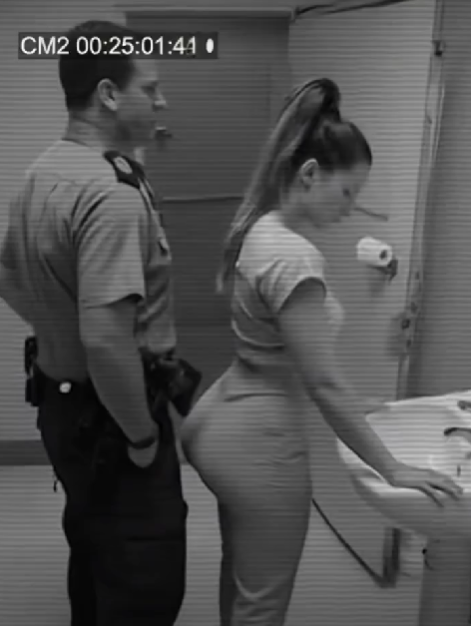
Moments before he was taken into custody, the officer—still in uniform—was left alone in the holding area.
“Tell Them I Was Trying to Protect Her”: The Shocking Security Footage That Changed Everything About a Police Officer’s Case
He looked around the room, pacing back and forth as though he could barely contain the weight of what was happening. For several moments, he appeared unable to decide what to do next. He stopped, stared at the floor, and finally lowered himself into a chair.
To anyone watching from the outside, it might have looked like an ordinary moment of nervousness from a man who knew his career was falling apart. He had been questioned, accused of interfering with an investigation, and suddenly found himself at the center of a controversy that threatened to destroy everything he had worked for.
But then, believing he was completely alone, he reached into his pocket.
What happened next would change the way thousands of people looked at the case.
He carefully pulled out a small photograph, holding it between his fingers as though it were something precious. His expression softened almost immediately. The tension in his shoulders seemed to disappear, replaced by a sadness that was difficult to hide.
He stared at the photograph for several seconds before bringing it to his lips and kissing it gently.
Then he whispered something under his breath.
“Tell them I was trying to protect her.”
According to the story surrounding the footage, those were the words that appeared to come from the officer as he sat alone in the room, his eyes filling with tears and his voice barely audible.
There was no dramatic speech. No attempt to convince an audience. No apparent awareness that anyone might be watching.
Just a man, a photograph, and a sentence that raised more questions than it answered.
The photograph reportedly showed a young girl, later described as his daughter. For people who had followed the allegations against him, that detail immediately introduced a deeply personal dimension to a story that had previously seemed straightforward.
Until that moment, many had viewed the officer through the lens of the accusations against him. He was the man suspected of interfering with an investigation, the individual whose actions had raised concerns among colleagues and investigators.
But the image of him holding that photograph created a different impression.
Suddenly, people were asking whether there was more to the story than anyone had initially understood.
And the most important question was no longer simply what he had done.
It was why.
What Really Happened That Day?
The controversy began when reports emerged alleging that the officer had interfered with an ongoing investigation. The details surrounding the incident became the subject of intense scrutiny, with questions being raised about his decisions, his professional responsibilities, and whether his actions had compromised an important case.
For an officer entrusted with enforcing the law, even the appearance of interference can have serious consequences.
Police officers are expected to follow established procedures, preserve evidence, and allow investigations to proceed without personal interests influencing their decisions. When an officer is suspected of crossing those boundaries, the public naturally expects answers.
Initially, the allegations appeared to tell a simple story.
An officer had allegedly done something he was not supposed to do, and investigators needed to determine whether he had violated the law or breached the standards of his position.
But the emotional moment captured in the footage complicated the public’s perception of the situation.
If the photograph really showed his daughter, and if his whispered words reflected what he genuinely believed, then the incident might have involved personal circumstances that had not been fully explained.
That possibility did not automatically mean he was innocent. Nor did it prove that his actions were justified.
It simply suggested that there might be another side to the story.
Was he attempting to protect someone from danger? Had he become involved in a situation that placed his family under pressure? Or was he struggling with the consequences of a decision he knew could have serious repercussions?
Without verified information about the underlying investigation, those questions remain unanswered.
Nevertheless, the footage became the center of a growing debate about responsibility, family, and the difficult decisions people sometimes face when their professional duties collide with their personal lives.
The Photograph That Changed the Conversation
There was something about the photograph that made the moment particularly powerful.
It was small enough to fit inside a pocket, yet it appeared to carry enormous emotional significance for the man holding it.
He did not appear to be addressing investigators or responding to questions. Instead, he seemed focused entirely on the person in the picture.
For a few seconds, the uniformed officer at the center of a serious controversy seemed to disappear, replaced by someone who might have been any parent worried about a child.
That contrast resonated with viewers.
People are accustomed to seeing police officers in situations involving authority, conflict, and public scrutiny. They are often judged according to their actions, their decisions, and their ability to remain professional under pressure.
But moments of private emotion can remind audiences that the people involved in these situations also have personal lives, relationships, fears, and responsibilities.
The photograph appeared to represent something beyond the investigation itself.
It represented the possibility that the officer’s actions were connected to someone he loved.
And for many viewers, that was enough to make them reconsider their initial assumptions.
Some began wondering whether the young girl had been involved in the events that led to the investigation. Others questioned whether the officer feared that someone might harm her or whether he believed that revealing certain information could place her at risk.
Still others suggested that the photograph might simply have reminded him of what he stood to lose if the allegations proved true.
None of those interpretations can be established from the emotional moment alone.
Yet the questions continued to spread, turning a case that had once appeared to be about professional misconduct into a wider discussion about the complicated relationship between personal loyalty and public responsibility.
The Internet Is Divided
Once the footage began circulating online, reactions quickly divided into two distinct camps.
One group argued that the officer’s apparent emotions should not distract from the seriousness of the allegations.
For these viewers, the central issue was straightforward: if someone in a position of authority interfered with an investigation, the circumstances needed to be examined carefully, regardless of the person’s reasons.
They pointed out that law enforcement officers have responsibilities that extend beyond their own families. Their decisions can affect victims, witnesses, suspects, colleagues, and members of the wider public.
Allowing personal feelings to influence an investigation could undermine trust in the entire system.
“Being a parent doesn’t put anyone above the law,” was the sentiment expressed by many who took this position.
Others, however, found themselves looking at the footage from a more emotional perspective.
They wondered whether the officer had been placed in an impossible situation, forced to choose between following a procedure and protecting someone he believed was in danger.
For these viewers, the photograph represented the possibility of a personal struggle that outsiders could not fully understand.
They argued that people should be careful about judging a complicated situation before all the relevant facts are known.
A decision that appears indefensible from the outside might have been made under pressure, they suggested, and understanding the circumstances is essential before reaching a conclusion.
But even among those who sympathized with the officer, there was disagreement.
Some believed that protecting a loved one could explain why someone acted in a particular way without necessarily making that action acceptable.
Others insisted that the full investigation needed to be completed before anyone could reasonably decide whether the officer had acted out of genuine concern, personal desperation, or some other motive.
The debate revealed how easily an emotional image can influence public opinion, even when it does not answer the most important factual questions.
Did He Break the Rules to Protect Someone He Loved?
This is the question that continues to hang over the story.
If the officer truly believed that his daughter was in danger, his actions might have been motivated by fear rather than personal gain. The thought of a child being harmed is enough to overwhelm even the calmest person, and parents can experience powerful instincts to intervene when they believe their family is threatened.
But instinct and judgment are not always the same thing.
In an investigation, a decision made with good intentions can still have serious consequences. Interfering with evidence, withholding information, or obstructing legitimate investigative work can damage a case and potentially prevent the truth from emerging.
That is why investigators must examine not only what happened but also the circumstances, the evidence, and the reasoning behind each decision.
The officer’s whispered words, if accurately represented, might offer a glimpse into his state of mind. They do not, by themselves, establish what he knew, what he intended, or whether his actions were lawful.
There is also another possibility.
The phrase “I was trying to protect her” could reflect a person’s sincere belief that he was doing the right thing, even if the available evidence ultimately showed that his decisions caused harm.
Human beings can act out of love, fear, loyalty, or desperation and still make mistakes.
Understanding a person’s motivation is important, but it is not the same as determining responsibility.
For that reason, the distinction between explaining an action and excusing it has become central to the discussion.
The officer may have been motivated by concern for his daughter. He may have misunderstood the situation. Or the full circumstances may be very different from what viewers have imagined.
Until reliable evidence establishes what happened, each possibility must remain a question rather than a conclusion.
The Human Side of a Public Controversy
One reason the footage has captured so much attention is that it highlights a tension people recognize in their own lives.
Many individuals have faced moments when their responsibilities to family members seemed to conflict with their obligations at work, their principles, or the rules they were expected to follow.
A parent might feel compelled to defend a child. An employee might struggle with whether to report a mistake made by someone they care about. A person might be forced to decide whether loyalty to a loved one should take priority over an uncomfortable truth.
These situations rarely offer simple answers.
However, the consequences can be especially serious when the person involved holds a position of public trust.
An ordinary private decision and a decision made by a police officer are not always comparable. Officers have legal duties, access to sensitive information, and responsibilities that require them to act within established boundaries.
That does not make their personal feelings irrelevant.
It means those feelings must be considered alongside the facts, the law, and the potential impact on others.
The photograph, therefore, should not be treated as proof of innocence or guilt. Its significance lies in the questions it raises about the person behind the allegations and the circumstances that may have influenced his behavior.
It reminds viewers that a case can involve more than one emotional truth, even when the final legal questions require clear answers.
A person can love their family deeply and still be accountable for their decisions.
Likewise, an accusation can be serious without every detail of the accused person’s motives being immediately obvious.
Both realities can exist at the same time.
What Happens Next?
As public interest grows, the most important unanswered questions remain tied to the evidence.
What exactly did the officer allegedly do? What information did he have at the time? Was anyone actually in danger? Did his actions interfere with the investigation, and if so, what consequences followed?
Most importantly, what did he mean when he whispered those words while holding the photograph?
Those questions cannot be answered by facial expressions, online speculation, or a few seconds of emotional footage.
They require a clear account of the events, reliable evidence, and a fair examination of the allegations.
If the officer broke the law, his reasons may help explain his behavior, but they would not automatically remove his responsibility. If the accusations were based on an incomplete understanding of the circumstances, the full facts would be necessary to establish that as well.
Until those details are confirmed, it is important to distinguish what the footage appears to show from what people have assumed it means.
The photograph may be emotionally powerful, but the truth of the case depends on more than a single moment.
One Whisper, Thousands of Questions
Perhaps the most striking part of the story is that the officer reportedly believed he was alone.
He was not delivering a statement to reporters. He was not attempting to persuade a jury or defend himself before the public. He was holding a photograph of a young girl and speaking quietly, seemingly unaware that his words might eventually become the subject of widespread attention.
“Tell them I was trying to protect her.”
The sentence is brief, but it leaves a long list of questions behind it.
Who was he hoping would understand? What did he believe he needed to protect the girl from? Was he remembering something that had already happened, fearing something that might happen, or struggling with the consequences of a choice he had made?
And was his understanding of the situation accurate?
Those are questions that only the facts can resolve.
For some viewers, the moment will remain a reminder that even people accused of serious wrongdoing may have complicated personal circumstances that deserve to be understood.
For others, it will be a reminder that emotional displays can influence public opinion before the evidence has been fully examined.
Both perspectives point toward the same conclusion: the full story matters.
The officer’s apparent pain may explain why people have become interested in his case, but it cannot replace a proper investigation. His relationship with the young girl may be deeply meaningful, but it does not independently establish what happened that day.
Ultimately, the public deserves answers based on evidence rather than assumptions, and everyone involved deserves a process that distinguishes facts from speculation.
The camera may have captured a private moment, but it did not necessarily capture the whole truth.
And until the missing pieces become clear, one question will continue to define the controversy:
Was he a man who crossed a line because he believed he was protecting someone he loved, or is there a very different explanation for what happened that day?
The answer may change how the case is understood.
But for now, the photograph, the whispered words, and the questions surrounding them remain a powerful reminder of how much can be hidden behind a single moment—and how dangerous it can be to mistake an emotional scene for the complete story.








Leave a Reply