

Some photographs capture extraordinary moments, while others leave people staring at their screens, desperately trying to figure out what they are actually looking at. At first glance, these images might appear completely ordinary, but one small detail can transform an innocent snapshot into a mind-bending visual puzzle.
From people who appear to have impossibly long legs to animals that seem to have extra heads, confusing reflections, and objects that look nothing like themselves, perspective can play some remarkable tricks on the human brain. Sometimes, the explanation is surprisingly simple. Other times, it takes several attempts to understand what is happening in the picture.
The internet has become a treasure trove of these bizarre photographs, with people sharing snapshots that seem almost impossible to explain until someone notices the crucial detail hiding in plain sight.
Here are 14 types of tricky pictures that demonstrate just how easily our eyes can deceive us.
1. The Person Who Appears to Have Three Legs
Imagine scrolling through your phone and suddenly encountering a photograph of someone who appears to have three legs. Your immediate reaction might be to question whether the image has been edited or whether something genuinely unusual has happened.
However, the explanation is often much less mysterious.
When two people stand close together, their legs can overlap in precisely the right way to create the illusion of an extra limb. One person’s trousers might blend seamlessly with another person’s clothing, making it difficult to distinguish where one body ends and another begins.
The confusion becomes even greater when everyone is wearing similar colours.
What makes these photographs particularly convincing is that the brain automatically attempts to organize the shapes into a recognizable human body. Instead of immediately recognizing two overlapping people, viewers may interpret the image as a single person with an impossible number of legs.
Once the correct perspective becomes clear, the illusion usually disappears almost instantly.
2. The Dog That Looks Like It Has Two Heads
Animal photographs are particularly effective at confusing people because pets rarely remain perfectly still for the camera.
A dog might turn its head at exactly the same moment another dog moves into the frame. If their bodies overlap, the resulting photograph can make them appear to share a single body or possess two heads.
At first, viewers may struggle to determine which head belongs to which animal.
The effect becomes even more convincing when both dogs have similar fur colours or markings. Their bodies can merge visually, producing an image that seems completely unnatural.
In some cases, the animals are simply standing behind one another, with their heads appearing on opposite sides of the same body.
The photograph itself may be entirely genuine. It is the timing and positioning that create the bizarre result.
And once somebody points out the second dog, the entire image suddenly makes sense.
3. The Floating Head That Seems to Have No Body
Few visual illusions are as unsettling as a photograph showing what appears to be a floating human head.
At first glance, the person might seem to have disappeared entirely, leaving only their face visible in the middle of the picture.
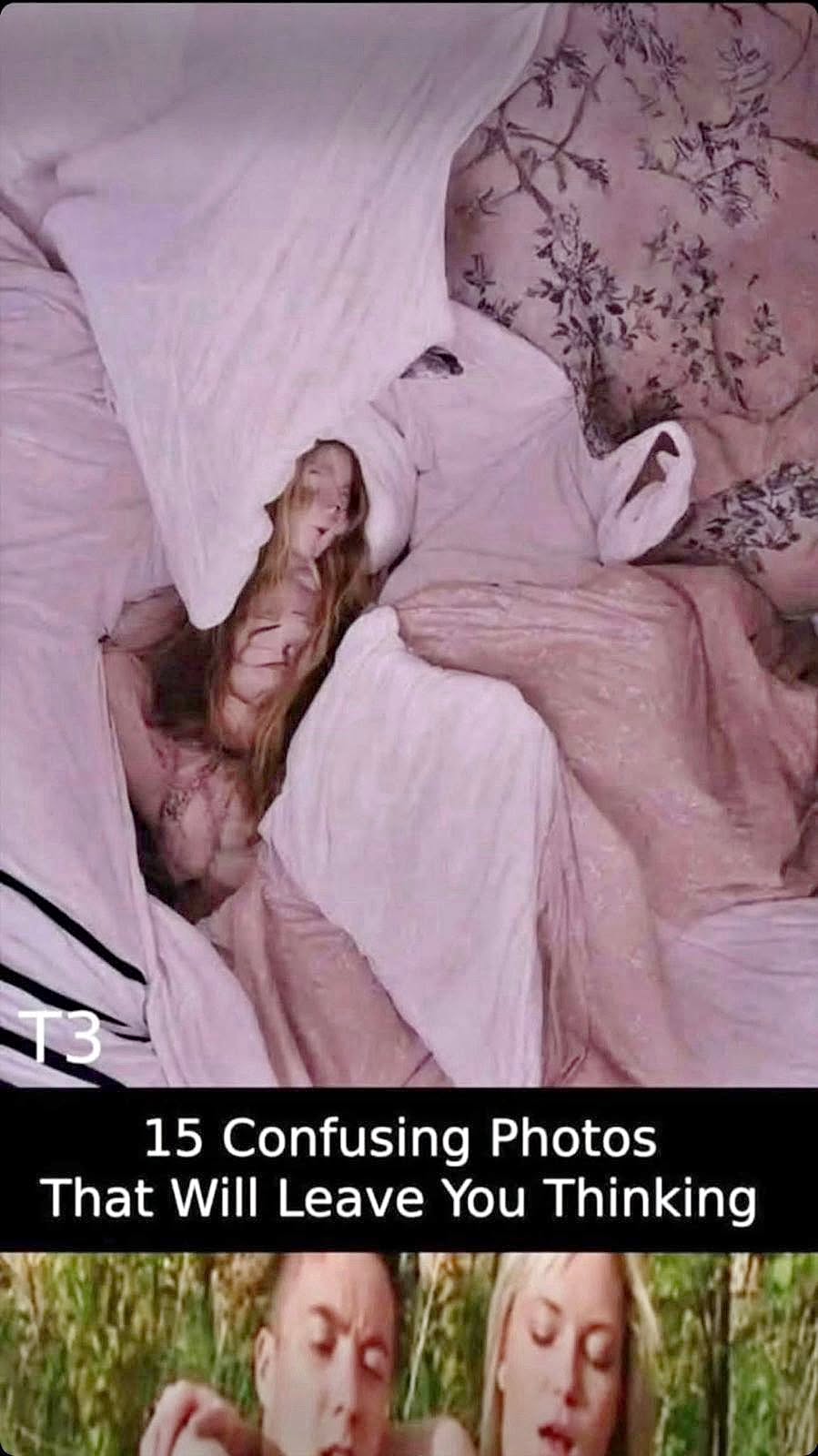
But the secret is often hidden in the clothing.
Someone wearing a shirt that closely matches the background might blend almost perfectly into their surroundings. If their shoulders and torso are positioned behind another object, the remaining visible features can create the impression that their head is floating independently.
Dark clothing against a dark background can produce a similar effect.
The brain relies heavily on contrast to distinguish objects from their surroundings. When that contrast disappears, the boundaries between different objects become difficult to recognize.
The result is a photograph that appears impossible until the viewer identifies the missing outline of the person’s body.
It is a simple reminder that seeing something and correctly understanding what we see are two very different things.
4. The Giant Hand That Looks Bigger Than Someone’s Head
Perspective can make ordinary objects appear dramatically different in size, particularly when they are photographed close to the camera.
A person holding their hand toward the lens might appear to have an enormous palm, while their head looks unusually small in comparison.
In reality, the hand has not changed size at all.
The camera captures objects according to their distance from the lens. Something positioned close to the camera can appear much larger than something farther away, even when the two objects are relatively similar in their actual dimensions.
Photographers sometimes use this effect deliberately to create playful images.
Someone might appear to hold the sun between their fingers, lift a distant building with one hand, or balance a friend on the palm of their hand.
Other times, the effect happens accidentally.
The funniest examples are often those in which the person has no idea how unusual the photograph looks until somebody shows them the finished image.
5. The Person Who Appears to Be Walking on Water
A photograph of someone apparently walking across a lake without sinking might initially look like something out of a fantasy film.
However, the illusion can often be explained by reflections, shallow water, and carefully aligned surroundings.
If the water is exceptionally calm, reflections of nearby objects can merge with the real scenery. A person’s legs might appear to extend into the reflection of a nearby structure, creating the impression that they are standing somewhere entirely different.
Another possibility is that the person is walking on a submerged platform or a shallow section of water that is difficult to distinguish from the surrounding surface.
Lighting can also make the water appear unusually solid.
Without obvious ripples or clear visual references, the brain may struggle to identify the exact boundary between the person’s feet and the water.
These photographs can be especially convincing when the horizon is hidden and the surface of the water blends into the background.
The result is a scene that looks impossible but may simply be an unusual combination of lighting and perspective.
6. The Tiny Person Standing Beside a Giant Shoe
Sometimes, a photograph can make an ordinary object look enormous while making a perfectly normal person appear incredibly small.
A giant shoe beside a miniature-looking human might suggest a scene from a science-fiction movie, but the explanation can be as simple as camera positioning.
If a shoe is held close to the lens while another person stands several feet behind it, the shoe can dominate the entire photograph.
The person in the background may appear tiny in comparison.
This technique is closely related to forced perspective, a photographic method that uses distance and positioning to manipulate the apparent size of objects.
It is the same principle that allows tourists to take pictures in which they appear to hold up the Leaning Tower of Pisa or push a massive building with one finger.
The objects do not need to be altered, and the image does not necessarily require editing.
All it takes is the right angle, the right distance, and a little imagination.
7. The Shadow That Appears to Belong to Someone Else
Shadows can be surprisingly deceptive, particularly when several people or objects are close together.
A photograph might show a person standing beside a strange shadow that appears to have a completely different shape from their body.
For a moment, the viewer might wonder whether the image contains something mysterious.
In reality, the shadow may belong to another person standing outside the frame, or it could be cast by an object positioned at an unusual angle.
The direction and length of a shadow depend on the position of the light source, the height of the object, and the surface on which the shadow falls.
When multiple shadows overlap, it becomes much harder to determine which shape belongs to which object.
Uneven ground can make the effect even more confusing.
A perfectly ordinary scene can therefore produce a shadow that looks like an entirely separate figure.
And because people naturally search for familiar shapes, viewers may see faces, animals, or human silhouettes where none actually exist.
8. The Reflection That Makes Someone Look Like a Different Person
Mirrors and reflective surfaces can turn an ordinary photograph into a surprisingly confusing puzzle.
A person standing beside a window might appear to have two faces, while someone looking into a shiny surface could seem to possess a completely different hairstyle or facial expression.
The confusion often occurs when reflections overlap with objects visible through the glass.
For example, a reflection of someone standing behind the photographer might appear directly beside the face of the person in the foreground. The two images can merge into one confusing composition.
Curved mirrors and reflective metal surfaces can distort shapes even further.
Water creates similar problems because reflections shift whenever the surface moves.
These photographs demonstrate how easily the brain can mistake reflected information for the physical objects around it.
The most convincing examples are often captured accidentally, without the photographer realizing that the reflection has created an entirely different scene.
9. The Cat That Appears to Have an Impossible Body
Cats are experts at squeezing themselves into unusual positions, which makes them perfect subjects for confusing photographs.
A cat curled into a tight ball might appear to have no visible legs, while another stretching behind a chair could seem to have an impossibly long body.
Their flexibility makes these illusions even more convincing.
When a cat’s paws disappear beneath its fur, its tail overlaps its legs, or its head rests against its body, the familiar outline of the animal becomes difficult to identify.
Dark fur against a dark sofa can make the situation even more confusing.
The viewer may initially interpret the photograph as showing an unusual creature rather than a perfectly normal household pet.
Then, after noticing a tiny paw or the outline of an ear, the entire image suddenly becomes understandable.
Cats might not understand why people find these photographs so amusing, but their unpredictable poses provide endless opportunities for accidental optical illusions.
10. The Person Whose Head Appears to Belong to Someone Else
This type of photograph can be especially confusing because the human brain is highly sensitive to faces.
When two people stand close together, one person’s head may appear perfectly positioned above another person’s body.
The result can look like an accidental body swap.
Imagine someone standing in the foreground while another person leans forward behind them. If their shoulders and clothing overlap, the photograph may appear to show a single person with a completely different face.
Similar clothing colours can make the illusion even more convincing.
The brain usually expects a person’s head, shoulders, and torso to form a familiar arrangement. When the photograph breaks that pattern, viewers may struggle to separate the individuals.
A slight movement of the camera could produce an entirely different result, revealing the two people clearly.
But when the timing is just right, the image becomes an unexpected visual puzzle that can take several seconds to solve.
11. The Building That Appears to Be Leaning at an Impossible Angle
Architecture photographs can be just as deceptive as pictures of people and animals.
A tall building might appear to bend sideways, lean dangerously over the street, or rise at an angle that seems physically impossible.
Sometimes, the building really does have an unusual architectural design.
However, many examples are caused by camera perspective.
When a photographer points a camera upward to capture a tall structure, the lines of the building can appear to converge. This effect is especially noticeable when the camera is tilted significantly.
Wide-angle lenses can exaggerate the distortion.
The result may make the building appear narrower at the top or dramatically tilted toward the centre of the image.
The surrounding structures can make the illusion even more convincing if they appear to lean in different directions.
Once the photograph is viewed from another angle, or its perspective is corrected, the building may look perfectly ordinary.
It is a useful example of how a camera records a three-dimensional world on a flat surface, sometimes producing results that look nothing like what a person remembers seeing.
12. The Foot That Appears to Be Longer Than an Entire Leg
Some photographs make ordinary body parts look so unusual that viewers immediately suspect digital manipulation.
A foot might appear enormous, a hand might look unusually long, or someone’s legs might seem to extend far beyond their natural proportions.
In many cases, the explanation is again the distance between the subject and the camera.
When a person’s foot is positioned close to the lens while the rest of their body extends into the background, the foot can appear disproportionately large.
The same thing happens when someone stretches their arm toward the camera.
The closer object occupies a larger portion of the image, while the body behind it appears smaller.
This effect is often exaggerated by wide-angle smartphone cameras, especially when photographs are taken from close distances.
The resulting image can look hilarious because the viewer instinctively compares body parts as though they were all positioned at the same distance.
But they are not.
A small change in camera placement can completely transform the proportions of the finished photograph.
13. The Ordinary Object That Looks Like Something Completely Different
Sometimes, the most confusing photographs do not involve people or animals at all.
A cloud might resemble a giant face, a tree stump could look like a sleeping animal, or a folded piece of clothing might appear to be an unfamiliar creature.
These images take advantage of a tendency known as pareidolia, in which the brain recognizes familiar patterns in random or ambiguous shapes.
Human beings are particularly good at identifying faces, even when the available information is incomplete.
Two dark marks and a curved line may be enough for someone to see a face in an ordinary object.
The same instinct helps explain why people recognize animals in clouds or imagine figures in the shadows.
In photographs, the effect becomes even more powerful because the image freezes an unusual arrangement of shapes at precisely the right moment.
Once someone identifies the supposed face or animal, it can become difficult to stop seeing it.
The object has not changed, but the viewer’s interpretation has.
14. The Photograph That Looks Completely Different the Second Time
Perhaps the most entertaining tricky pictures are those that appear ordinary at first but become increasingly bizarre the longer someone looks at them.
A person might seem to be standing in an impossible position. A distant object may resemble something enormous. An innocent background detail could completely change the meaning of the scene.
The first impression is often misleading because the brain rapidly creates an explanation for what the eyes are seeing.
It does not always wait until every detail has been examined.
Instead, the brain uses familiar patterns, previous experiences, and surrounding information to interpret the image as quickly as possible.
Usually, this process works remarkably well.
But when a photograph contains overlapping objects, unusual angles, confusing shadows, or unexpected proportions, that rapid interpretation can go wrong.
The viewer may then need to look again, trace the outlines of individual objects, and reconsider how everything fits together.
Sometimes, the solution is obvious once it has been noticed. In other cases, the photograph remains confusing even after several attempts.
That is exactly what makes these pictures so entertaining.
They encourage people to question their first impressions and pay attention to details they would otherwise ignore.
And with millions of photographs being shared online, there will always be another perfectly timed snapshot waiting to confuse viewers all over again.











Leave a Reply