
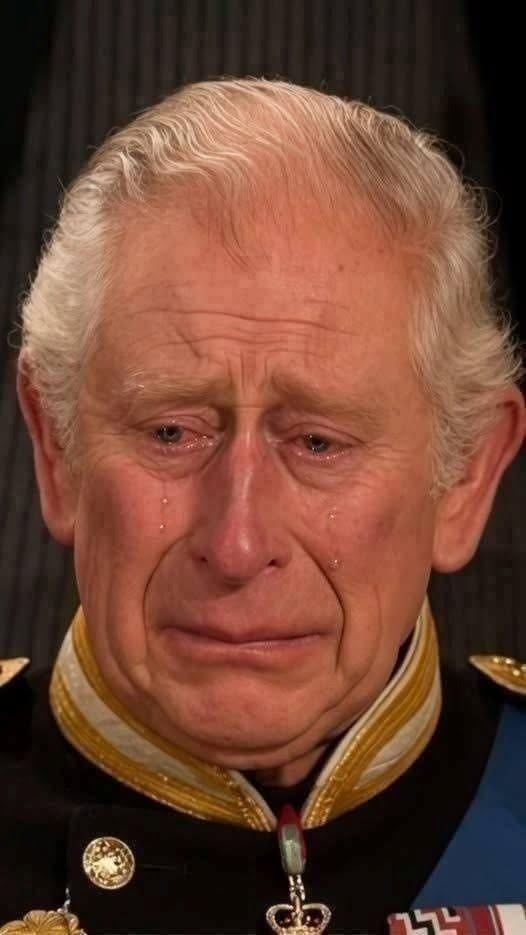
A photograph showing King Charles III with tears on his face has drawn attention to the emotional side of royal life. The image portrays the British monarch wearing formal attire, with a solemn expression that has prompted viewers to wonder what might have been happening when the photograph was taken.
Headlines suggesting that the King has made a sad announcement about Prince William may attract considerable curiosity. However, the photograph alone does not establish the circumstances behind his expression, and the claim of a recent announcement should not be treated as confirmed without reliable evidence.
The British Royal Family regularly attracts international attention, from official engagements and important national occasions to personal reflections on family, responsibility, and the future of the monarchy.
In the photograph, King Charles appears visibly emotional. His eyes are watery, and his expression seems serious as he looks downward. He is dressed in a formal royal uniform decorated with gold detailing and medals.
Images of public figures can generate strong reactions because people often associate their expressions with important moments in their lives. When a monarch known for ceremonial appearances is photographed looking emotional, viewers may naturally wonder about the circumstances.
Nevertheless, a photograph captures only a brief moment. Without verified information about when and where it was taken, it is impossible to determine whether the King was responding to a personal matter, a solemn public occasion, or something else entirely.
The distinction is particularly important when a photograph is shared alongside a dramatic headline. A compelling caption can encourage people to draw conclusions that the available evidence does not support.
Responsible reporting should therefore begin with what is actually known rather than assumptions about the people appearing in the image.
King Charles and His Responsibilities as Monarch
King Charles III became Britain’s monarch following the death of his mother, Queen Elizabeth II, in September 2022. His accession marked a historic transition for the United Kingdom and the wider Commonwealth.
As sovereign, Charles undertakes constitutional duties, represents the nation at official occasions, welcomes visiting leaders, and supports numerous charitable and public causes.
The role also places him under constant public scrutiny. His words, appearances, and decisions are regularly examined by journalists and royal observers, making even seemingly small moments a subject of discussion.
Despite the formal nature of the position, the King is also a person with family relationships and private emotions. Public responsibilities do not remove the ordinary human experiences that can accompany family life, personal challenges, or significant events.
However, understanding the pressures of royal life does not mean that observers can determine the cause of an emotional expression from a photograph alone.
Prince William and the Future of the Monarchy
Prince William, the Prince of Wales, is first in line to the British throne. As the King’s eldest son and heir, he plays an important role in the monarchy’s public activities and future direction.
Over the years, William has undertaken official engagements involving charitable organizations, environmental initiatives, community projects, and other public causes. His responsibilities have grown as he prepares for the possibility of one day becoming king.
His position means that his relationship with King Charles attracts considerable interest. Observers often discuss how the two generations approach their duties and how the monarchy may evolve over time.
Yet the relationship between a father and son cannot be fully understood through public appearances or isolated photographs. Both men have official responsibilities, but their private conversations and personal experiences are not necessarily visible to the public.
Claims about disagreements, difficult family news, or major decisions should therefore be supported by credible reporting rather than speculation.
Why Royal Family Stories Attract So Much Attention
The British Royal Family has a long history of public interest. Royal weddings, official ceremonies, family milestones, and national commemorations regularly receive coverage across television, newspapers, and digital platforms.
Part of this interest comes from the monarchy’s historical role. Another part comes from the contrast between public duty and private life.
People may be interested in how members of the Royal Family balance their responsibilities with relationships, parenthood, and personal challenges. These themes are familiar to audiences, even though royal life involves circumstances that differ considerably from those experienced by most families.
Social media has further increased the speed at which royal photographs circulate. A single image can reach audiences worldwide within minutes, sometimes accompanied by captions that provide little context.
While this can encourage discussion about important events, it can also allow misleading interpretations to spread before the facts have been established.
Readers benefit from checking whether a story has been reported by reliable news organizations or confirmed through an official royal announcement.
A Recent Public Moment Involving King Charles and Prince William
The King and Prince William appeared together publicly with Queen Camilla in Aberfan, Wales, on October 21, 2026, to commemorate the 60th anniversary of the Aberfan disaster. The royal family visited the memorial garden, laid wreaths, and met members of the community as they remembered the 144 people who died in the 1966 tragedy.
The commemoration was a solemn occasion centered on remembrance, the experiences of bereaved families, and the community’s resilience.
Such events illustrate why photographs of senior royals can sometimes convey powerful emotions. Public commemorations often involve reflecting on loss, the passage of time, and the experiences of people affected by historical tragedies.
However, this documented event does not establish that the photograph accompanying the viral headline was taken at Aberfan. Nor does it confirm that King Charles made a new announcement about Prince William.
Those claims require separate verification.
The Importance of Separating Facts From Speculation
Dramatic headlines often use phrases such as “sad announcement” or “emotional moment” to encourage readers to discover what happened. Although these expressions can create curiosity, they can also imply that a significant event has been confirmed when the evidence is incomplete.
When a story concerns a public figure, readers should consider several questions.
Was an announcement actually made? Is there a statement from Buckingham Palace? Have reputable news organizations independently reported the same information? Does the photograph come with a verified date and explanation?
These checks can help readers distinguish between confirmed news and content designed primarily to attract clicks.
The same principle applies to stories about Prince William. His position as heir to the throne makes developments involving him newsworthy, but that does not mean every online claim about him is accurate.
A careful approach protects the quality of reporting and helps prevent unnecessary confusion among readers.
Beyond ceremonies and constitutional duties, members of the Royal Family experience many of the same broad emotions as other people. Family relationships, remembrance, responsibility, and major life transitions can all carry personal significance.
For King Charles, the transition from heir to monarch represented a major change in his public role. For Prince William, preparing for future responsibilities involves balancing his current duties with the expectations associated with his position.
These circumstances provide a meaningful context for discussing the human side of monarchy without inventing private events or attributing unverified statements to either man.
Public figures deserve accurate reporting just as much as private individuals do. Their prominence does not make unsupported personal claims reliable.
The photograph of King Charles III offers a striking image of a monarch appearing emotional, while the accompanying headline raises questions about Prince William and an alleged announcement.
However, the image does not independently confirm what happened, why the King appeared emotional, or whether the reported announcement took place.
The documented joint appearance by King Charles, Queen Camilla, and Prince William at the Aberfan commemoration provides a genuine example of the family attending a solemn public event together. It should not, however, be presented as the explanation for an unrelated or undated photograph.
Until the specific claim is supported by a reliable source, readers should approach it cautiously.
Royal stories can be compelling without exaggeration. By focusing on confirmed events, acknowledging uncertainty, and respecting the distinction between public duties and private life, publishers can provide engaging coverage while helping readers understand what is known and what remains unverified.











Leave a Reply