
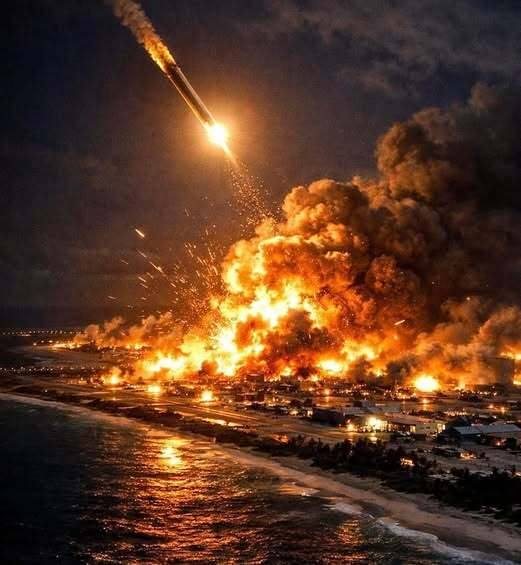
In the high-velocity landscape of 2026, where a single notification can ripple across the globe in milliseconds, the distinction between a major international crisis and a viral fabrication has never been more critical. Recently, a dramatic and highly specific claim began to colonize social media feeds, suggesting that Iran had launched a direct missile strike against a United States military installation located on the remote island of Diego Garcia.
The reports, often characterized by urgent, emotionally charged language, described a long-range ballistic missile traversing thousands of kilometers to inflict significant damage on one of the most strategically guarded facilities in the Indian Ocean. However, as is often the case with sensational digital rumors, a closer examination reveals a stark absence of verified evidence, highlighting a growing tension between the speed of information and the necessity of truth.
To fully understand why a claim of this magnitude—despite lacking verification—can still spread rapidly and gain significant traction, it is necessary to look far beyond the surface of the statement itself and examine the deeper psychological, social, and technological mechanisms that allow such narratives to thrive in today’s information ecosystem. We live in a time where information travels faster than ever before, and the speed at which something spreads is often mistaken for its accuracy. This creates an environment where emotionally compelling or strategically framed claims can capture attention instantly, even when there is little to no factual basis supporting them.
One of the most important factors behind the rapid spread of such claims is the human tendency to react strongly to perceived threats, especially those involving global security, military conflict, or geopolitical instability. When people encounter information suggesting that a major military installation may be under threat, their natural response is heightened attention and concern. This reaction is rooted in basic psychological instincts tied to survival and risk assessment. In other words, our brains are wired to prioritize alarming information, even before we have had time to verify it. As a result, content that triggers fear, urgency, or curiosity is far more likely to be shared, discussed, and amplified across social platforms.
The mention of Diego Garcia plays a central role in making such a claim appear believable. This is not a random or obscure location—it is a highly strategic military base with global significance. Located in the middle of the Indian Ocean, Diego Garcia serves as a critical operational hub for both the United Kingdom and the United States. It supports long-range bomber missions, acts as a logistics center for naval forces, and provides advanced intelligence, surveillance, and reconnaissance capabilities across vast regions, including the Middle East and the Indo-Pacific. Because of its importance, the mere suggestion that something unusual or dangerous is happening there immediately elevates the perceived credibility of the claim.
However, this is precisely where critical thinking becomes essential. While the strategic importance of Diego Garcia is very real, that same importance also makes it highly unlikely that any major incident involving the base would go unreported by official channels. In today’s interconnected and highly monitored world, events of global significance are extremely difficult to conceal. Governments, defense agencies, and independent analysts continuously track military activity using a combination of satellite imagery, intelligence sharing, and open-source data. If there were any credible threat or incident at a location as important as Diego Garcia, it would almost certainly be confirmed through multiple reliable sources within a very short period of time.
Major international news organizations such as BBC and The Wall Street Journal play a key role in this verification process. These institutions have established networks of journalists, analysts, and official contacts that allow them to quickly assess the validity of breaking news. When a significant geopolitical event occurs, they provide continuous coverage, expert analysis, and updates based on verified information. The absence of reporting from such reputable outlets is a strong indicator that a widely circulating claim may not be grounded in reality.
Another crucial element to consider is the role of social media algorithms in amplifying unverified information. Platforms are designed to maximize user engagement, which often means promoting content that generates strong emotional reactions. Posts that evoke fear, outrage, or surprise are more likely to be shared, commented on, and liked, which in turn increases their visibility. This creates a feedback loop where sensational claims gain traction simply because they provoke a reaction, not because they are accurate. Over time, repeated exposure to the same claim—even without evidence—can make it feel more credible, a phenomenon known as the “illusion of truth” effect.
In addition to algorithmic amplification, there is also the issue of information fragmentation. People often consume news within echo chambers, where they are primarily exposed to viewpoints that align with their existing beliefs or interests. In such environments, unverified claims can spread unchecked, as there may be little incentive or opportunity to challenge them with factual information. This further reinforces the perception that the claim is valid, even in the absence of credible evidence.
It is also worth noting that the strategic use of real-world details—such as the mention of a known military base—adds a layer of authenticity to otherwise speculative narratives. By anchoring a claim in something that is widely recognized as important, it becomes easier to blur the line between fact and fiction. This technique is often used, intentionally or unintentionally, to make a story more compelling and believable.
Despite all these factors, the lack of confirmation from official government statements, defense monitoring systems, and reputable news organizations remains one of the strongest indicators that the narrative is likely speculative. In the case of a location as critical as Diego Garcia, even minor incidents would typically generate some form of official acknowledgment or media coverage. The complete absence of such confirmation suggests that the claim does not reflect a real-world event.
Ultimately, this situation highlights a broader challenge in the digital age: the need for individuals to actively evaluate the information they encounter. Access to information has never been greater, but with that access comes the responsibility to distinguish between verified facts and unsubstantiated claims. This requires a combination of critical thinking, media literacy, and a willingness to seek out reliable sources before drawing conclusions.
In conclusion, while the claim may appear plausible at first glance—largely due to the strategic importance of Diego Garcia and the way it is presented—a deeper analysis reveals significant reasons for skepticism. The psychological appeal of alarming information, the amplification effects of social media, and the absence of credible verification all point toward the same conclusion: the narrative is far more likely to be a product of speculation than a reflection of reality. Understanding these dynamics is essential not only for interpreting this specific claim but also for navigating the complex and often misleading information landscape of the modern world.











Leave a Reply