
The warning did not arrive with sirens or breaking headlines. There were no urgent alerts flashing across screens, no dramatic interruptions to daily life. Instead, it emerged quietly—buried within technical reports, scientific briefings, and carefully worded statements designed more to inform than to alarm. It was presented with calm precision, wrapped in the kind of language that reassures as much as it explains.
At first glance, it seemed routine.
After all, Earth is constantly surrounded by cosmic debris. Thousands of asteroids pass through our solar neighborhood every year, most of them harmless, many of them barely noticed outside scientific circles. Astronomers track these objects methodically, assigning them catalog numbers, calculating their trajectories, and predicting their paths with increasing accuracy. For the vast majority, the outcome is predictable: they pass by at a safe distance and fade back into obscurity.
This appeared to be one of those cases.
But then, something shifted.
It wasn’t a sudden revelation, but a gradual change—subtle, almost imperceptible at first. As additional observations were collected and analyzed, new data began to refine earlier assumptions. Size estimates grew more precise, and with that precision came a quiet realization: this object was larger than initially thought. Not enormous by cosmic standards, but large enough to command attention.
The tone of the discussion began to evolve.
What had once been described casually as “just another asteroid” slowly took on a more serious characterization. Scientists remained composed, as they always do, but the language became more careful, more deliberate. This was no longer simply a routine flyby—it was an opportunity to examine a class of objects that, under the wrong circumstances, could pose a genuine threat to life on Earth.
The object in question carries the designation 52768 (1998 OR2).
To most people, the name means very little. It is a product of a systematic naming convention, a sequence of numbers and letters that reflects the order of its discovery rather than its significance. Yet behind that cold, technical label lies something far more substantial: an asteroid estimated to measure between 1.5 and 4 kilometers in diameter.
In the vast emptiness of space, such dimensions may not seem extraordinary. But when considered in the context of Earth, they take on an entirely different meaning.
An object of this size is not merely a local hazard. It is a global one.
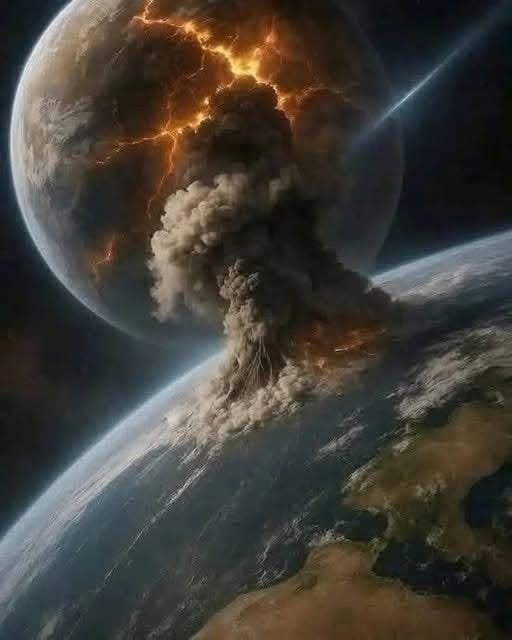
If an asteroid like 52768 (1998 OR2) were ever to collide with Earth, the consequences would unfold on a scale that defies ordinary experience. The initial impact alone would release energy far beyond anything humanity has ever produced—equivalent to millions of nuclear detonations occurring in a single instant. The force would vaporize everything at the point of contact, carving a massive crater into the Earth’s surface and sending shockwaves rippling across continents.
But the destruction would not end there.
The true danger lies in what follows.
Material ejected into the atmosphere would rise high above the planet, forming a dense cloud of dust, ash, and debris. This layer could block sunlight for months or even years, dramatically lowering global temperatures. Crops would fail. Ecosystems would collapse. The delicate balance that sustains life would be disrupted on a planetary scale.
This phenomenon, often referred to as an “impact winter,” represents one of the most severe consequences of a large collision. It is not the immediate explosion that poses the greatest threat to humanity—it is the long-term environmental aftermath.
At the same time, the heat generated by the impact would ignite widespread fires. Forests, grasslands, and urban areas alike could burn simultaneously, sending even more smoke into the atmosphere. If the asteroid were to strike an ocean, the result would be equally catastrophic: massive tsunamis radiating outward, capable of devastating coastlines thousands of kilometers away.
To fully grasp the significance of such an event, we must look to Earth’s past.
Our planet bears the scars of previous impacts, some of which have reshaped the course of life itself. The most well-known example is the Chicxulub impact event, which occurred approximately 66 million years ago. That collision involved an asteroid roughly 10 kilometers in diameter and is widely believed to have contributed to the extinction of the dinosaurs.
While 52768 (1998 OR2) is smaller, it still occupies a size range capable of producing devastating consequences. It may not cause a mass extinction on the same scale, but it could trigger global disruptions severe enough to challenge modern civilization.
Even smaller objects have demonstrated the destructive power of cosmic impacts.
The Tunguska event, for example, flattened an estimated 2,000 square kilometers of forest in Siberia despite being caused by an object likely less than 100 meters in diameter. More recently, the Chelyabinsk meteor exploded in the atmosphere, generating a shockwave that damaged buildings and injured over a thousand people.
These events serve as reminders that the threat is not hypothetical. It is real, measurable, and grounded in observable history.
Fortunately, humanity has not remained passive in the face of this risk.
Organizations such as NASA and its Center for Near Earth Object Studies have developed advanced systems to detect and track near-Earth objects. Using networks of telescopes and sophisticated computational models, scientists can monitor thousands of asteroids simultaneously, calculating their orbits with remarkable accuracy.
In the case of 52768 (1998 OR2), these efforts have been highly successful.
The asteroid moves at an extraordinary speed—approximately 8.7 kilometers per second. Despite this, its trajectory has been mapped with precision, allowing scientists to predict its path far into the future. Current calculations confirm that it will pass safely by Earth, maintaining a distance that eliminates any possibility of impact.
In astronomical terms, this is considered a “close approach.” In practical terms, it is entirely safe.
There is no hidden danger. No unexpected deviation. No reason for alarm.
And yet, the importance of this event lies not in the risk it poses, but in the awareness it creates.
Because for every object we detect, there may be others we have yet to find.
Detection remains one of the greatest challenges in planetary defense. Larger asteroids are easier to identify, but smaller ones can evade observation until they are dangerously close. The Chelyabinsk meteor, for instance, approached from the direction of the Sun, rendering it nearly invisible to traditional observation methods.
This underscores a critical reality: early detection is everything.
With sufficient warning, humanity has options. Missions like the DART mission have already demonstrated that it is possible to alter an asteroid’s trajectory through direct impact. By slightly changing its orbit, scientists can ensure that a future collision is avoided.
But such strategies depend on time.
Years, or even decades, of advance notice would allow for careful planning and execution. Without that time, our options become far more limited.
And beyond the technical challenges lies another layer of complexity: global coordination.
An asteroid impact is not a regional problem—it is a planetary one. Responding effectively would require cooperation across nations, institutions, and political systems. Decisions would need to be made quickly, based on scientific evidence and shared priorities. Delays, disagreements, or lack of preparation could have serious consequences.
There is also the question of investment.
Planetary defense often competes with more immediate concerns for funding and attention. Yet the scale of the potential risk is so large that even a low probability demands serious consideration. Preparing for rare but catastrophic events is not easy—but it is necessary.
This is why encounters like 52768 (1998 OR2) matter.
They serve as reminders.
They bring abstract risks into sharper focus. They encourage continued research, improved detection systems, and the development of new technologies. They prompt discussions about preparedness—not out of fear, but out of responsibility.
For now, the situation is under control.
The asteroid will pass safely. Its trajectory is well understood. Scientists will continue to monitor it, ensuring that any future changes are detected early.
But the larger question remains.
Are we ready for the one that won’t pass safely?
Because somewhere in the vastness of space, countless objects continue their silent journeys. Most will never come close to Earth. Some will pass within measurable distance. And one day—whether years, decades, or centuries from now—one may be on a collision course.
When that moment comes, the outcome will not be determined by chance alone.
It will depend on preparation.
On the systems we build today. On the knowledge we continue to develop. On the willingness of humanity to look beyond immediate concerns and prepare for long-term risks.
The future is not entirely unpredictable.
But it is shaped by what we choose to do in the present.
And in the quiet passage of an asteroid like 52768 (1998 OR2), we are given something rare and valuable:
Time.
Time to observe.
Time to learn.
And most importantly, time to prepare.











Leave a Reply