
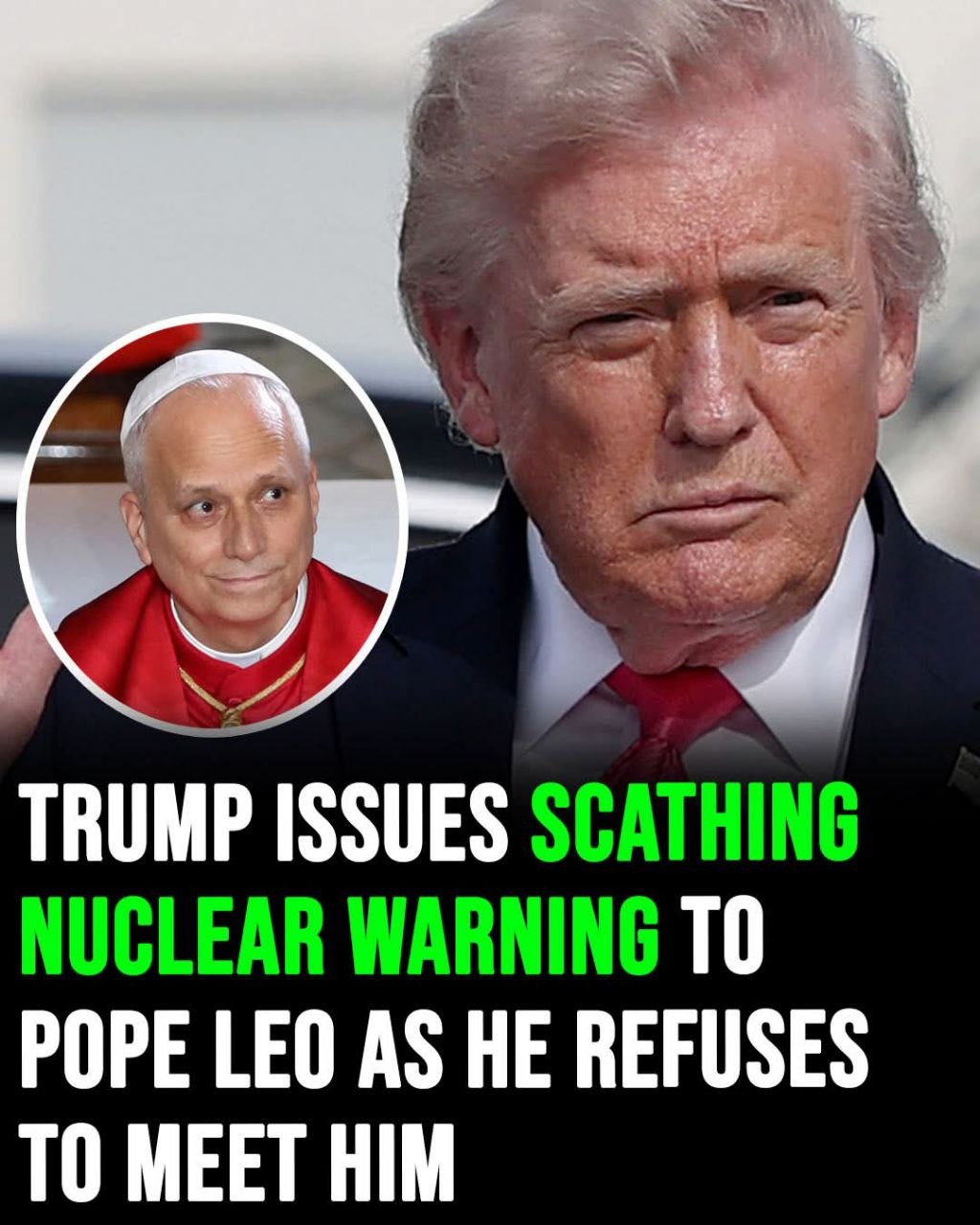
Donald Trump issues bombshell nuclear warning to Pope Leo as he refuses to meet him
What unfolded was more than a spat between a president and a pope; it was a collision between two rival moral universes. On one side, Pope Leo stood in a packed cathedral in Cameroon, condemning “tyrants” who pour billions into war while the poor are left to bleed. On the other, Donald Trump framed himself as the last barrier between Iran and nuclear catastrophe, insisting he was “not fighting with” the pontiff even as he misrepresented Leo’s position.
The Vatican’s record is clear and consistent: Pope Leo has repeatedly and unequivocally denounced nuclear weapons, framing them not only as instruments of war but as profound moral failures that threaten the very fabric of human dignity and global coexistence. In numerous addresses, statements, and diplomatic efforts, he has called for comprehensive disarmament, emphasizing dialogue, mutual trust, and international cooperation as the only sustainable path toward lasting peace. His vision is not merely the absence of conflict, but the presence of justice—a world in which nations no longer rely on the logic of deterrence or fear, but instead commit themselves to solidarity and the common good. In his words, humanity must strive for a future “free from the nuclear threat,” a future where technological advancement is guided by ethical responsibility rather than destructive capability.
Against this backdrop, the claim by Donald Trump that the pope would somehow tolerate or permit Iran to acquire nuclear weapons stands in stark contradiction to both the Vatican’s official stance and the broader moral framework that underpins it. Such a statement does more than misrepresent a religious leader; it distorts a carefully articulated ethical position for political purposes, turning a voice of moral authority into a convenient instrument within a polarized geopolitical narrative. By doing so, it not only risks misleading the public but also undermines the credibility of genuine efforts toward diplomacy and peacebuilding.
This tension between political rhetoric and moral clarity opens onto an even deeper and more intricate question—one that resists easy answers and cannot be neatly resolved through tweets, headlines, or partisan talking points. It forces us to confront the very foundations of how peace is defined, pursued, and sustained in a world shaped by competing interests and conflicting values. When global power structures, national security imperatives, and deeply held philosophical or religious beliefs intersect, the question of authority becomes unavoidable: who, if anyone, has the legitimacy to define what peace truly means? Is it the political leaders who wield military and economic power, navigating the harsh realities of international conflict and often invoking fear, deterrence, and strategic dominance as necessary tools to maintain stability? Or is it the moral and spiritual figures who, unburdened by the immediate pressures of governance, appeal instead to human conscience—calling on societies to transcend cycles of violence and to imagine a world grounded in compassion, dialogue, and mutual respect?
This dilemma is not merely theoretical; it plays out constantly on the global stage, where decisions made in moments of crisis can have consequences that echo across generations. Political leaders may argue that peace is something fragile, something that must be protected through strength, vigilance, and, at times, the credible threat of force. From this perspective, peace is less an ideal to be perfected and more a condition to be managed—maintained through careful calculations of risk, alliances, and deterrence strategies. Yet moral and religious voices challenge this framework, insisting that such an approach, while perhaps effective in the short term, ultimately perpetuates a cycle of fear and mistrust. They argue that true peace cannot be built on the constant readiness for violence, but must instead arise from justice, reconciliation, and a genuine commitment to the dignity and worth of every human being.
In this collision of power, fear, and faith, the concept of peace itself becomes contested terrain, shaped by differing assumptions about human nature, responsibility, and the possibility of change. On one side lies a worldview grounded in pragmatism and realpolitik, where the imperfections of human behavior are taken as a given and policies are crafted accordingly. On the other side stands a vision rooted in ethics and universal values, one that dares to imagine that humanity is capable of something more—that cooperation can replace conflict, that understanding can overcome division, and that moral progress is not only possible but necessary.
The gap between these perspectives is not simply a difference in strategy or emphasis; it reflects a profound divergence in how the world is understood and how its future is imagined. For some, peace is inseparable from power—the ability to prevent conflict through strength and to enforce stability when it is threatened. For others, peace is inseparable from justice—the creation of conditions in which conflict becomes less likely because inequality, oppression, and fear have been addressed at their roots. These are not easily reconciled positions, and yet both claim, in their own ways, to seek the same end.
Ultimately, the question remains unresolved and perhaps unresolvable in simple terms: who truly speaks for peace on the global stage? Is it those who hold the levers of power and bear the responsibility of protecting nations in an uncertain and often dangerous world? Or is it those who challenge power, who question its assumptions, and who call humanity to a higher moral standard—even when such calls seem impractical or idealistic? Perhaps the answer lies not in choosing one voice over the other, but in acknowledging the necessity of both—the tension between them serving as a kind of moral compass.
In recognizing this tension, there is also an opportunity. It invites a more nuanced understanding of peace, one that does not reduce it to either force or idealism alone, but sees it as a dynamic and ongoing process requiring both practical wisdom and moral courage. It challenges leaders to listen not only to advisors and strategists but also to voices of conscience, and it challenges moral authorities to engage with the complexities of the real world rather than speaking only in abstractions. In doing so, it opens the possibility of a more integrated approach—one in which power is guided by principle, and principle is informed by reality.
Even in a world shaped by fear, competition, and uncertainty, the presence of these competing perspectives ensures that the conversation about peace does not fade into silence or become a fixed and unquestioned idea. Instead, it remains alive—constantly debated, reexamined, and redefined in response to changing realities and new challenges. This ongoing tension between different visions of peace—whether rooted in power or principle, security or justice—prevents complacency and forces societies to confront uncomfortable truths about their own values and priorities. In this sense, disagreement itself becomes a kind of safeguard, ensuring that peace is not reduced to a convenient slogan or an empty political promise, but remains a subject of genuine moral and intellectual engagement.
Perhaps this is not a weakness, but a necessary condition for progress. A world in which peace is never questioned might also be a world in which it is poorly understood or superficially maintained. By contrast, a world in which peace is continuously examined—through debate, reflection, and even conflict of ideas—creates space for growth, learning, and transformation. It encourages individuals and nations alike to ask not only how peace can be achieved, but what kind of peace is worth striving for. Is it a peace built on silence and control, or one grounded in justice, dignity, and mutual respect? These are not easy questions, but they are essential ones.
For as long as the voice of conscience continues to question, to challenge, and to inspire, there remains a vital counterbalance to the forces of fear and domination. This voice may not always be the loudest, nor the most powerful in a conventional sense, but its influence lies in its persistence and its moral clarity. It reminds humanity that survival alone is not enough—that a world free from immediate conflict is not necessarily a world that is truly at peace. True peace demands more: it requires empathy in place of indifference, dialogue instead of division, and a willingness to confront injustice rather than ignore it.
In this light, hope becomes something more than a passive expectation; it becomes an active commitment. It lives in the decisions of leaders who choose diplomacy over aggression, in the efforts of communities that seek reconciliation over revenge, and in the quiet determination of individuals who refuse to accept hatred or violence as inevitable. It is sustained by the belief that, despite the weight of history and the persistence of conflict, humanity is capable of change—that it can learn, evolve, and move closer to a more just and compassionate way of living together.
Therefore, peace should not be understood as a distant ideal or a final destination, but as an ongoing process—fragile, complex, and deeply human. It is something that must be built, protected, and renewed across generations, shaped by both the realities of the world and the aspirations that push beyond them. And as long as the conversation continues—as long as voices of conscience are neither silenced nor ignored—there remains the possibility that peace will be pursued not merely as the absence of war, but as a richer and more meaningful expression of our shared humanity, rooted in dignity, understanding, and a genuine commitment to the common good.
The passage describes a high-profile clash between Donald Trump and Pope Leo, presenting it as far more than a simple disagreement between two influential figures. Instead, it frames the situation as a deeper conflict between two fundamentally different moral and political worldviews. On one side stands Pope Leo, speaking from a moral and spiritual perspective, condemning global injustice and criticizing leaders who invest heavily in war while neglecting the suffering of the poor. On the other side is Donald Trump, positioning himself as a protector of global security, particularly in relation to the threat of nuclear weapons and Iran, while simultaneously mischaracterizing the pope’s stance.
At the heart of the text is the Vatican’s clear and consistent opposition to nuclear weapons. Pope Leo is portrayed as a strong advocate for disarmament, dialogue, and international cooperation, emphasizing that nuclear weapons are not just tools of war but moral failures that endanger humanity as a whole. His vision of peace goes beyond simply avoiding conflict; it is rooted in justice, human dignity, and a commitment to the common good. He calls for a world free from nuclear threats, where technological progress is guided by ethical responsibility rather than destructive potential.
The text argues that Trump’s claim—that the pope would allow Iran to develop nuclear weapons—is not only inaccurate but also distorts the pope’s moral position for political purposes. This misrepresentation is presented as part of a broader pattern in which complex ethical viewpoints are simplified or manipulated within political narratives, potentially misleading the public and weakening genuine efforts toward peace and diplomacy.
Beyond the immediate disagreement, the passage explores a broader philosophical question about who has the authority to define peace in today’s world. It highlights the tension between political leaders, who often rely on power, deterrence, and strategic thinking to maintain stability, and moral or religious figures, who emphasize ethics, justice, and human conscience. This tension reflects two different approaches to peace: one grounded in realism and the practical need to manage conflict, and the other rooted in ideals that seek to transform the underlying causes of violence.
The text suggests that this conflict is not just about strategy but about fundamentally different ways of understanding the world. For some, peace is maintained through strength and the ability to deter threats; for others, it can only be achieved by addressing injustice and fostering genuine reconciliation. While these perspectives may seem incompatible, both claim to pursue the same ultimate goal—lasting peace.
In the end, the passage does not offer a simple answer to the question of who truly speaks for peace. Instead, it argues that the tension between these competing perspectives is necessary and even valuable. This ongoing debate keeps the concept of peace dynamic and prevents it from becoming an empty or superficial idea. It encourages continuous reflection on what peace should look like and how it can be achieved.
The conclusion emphasizes that peace should be understood not as a fixed endpoint but as an ongoing process that requires both practical action and moral vision. It calls for a balance between power and principle, suggesting that true progress depends on integrating political realities with ethical considerations. Ultimately, as long as voices of conscience continue to challenge, question, and inspire, there remains hope that peace will be pursued not just as the absence of war, but as a deeper expression of shared human values such as dignity, justice, and compassion.









Leave a Reply