
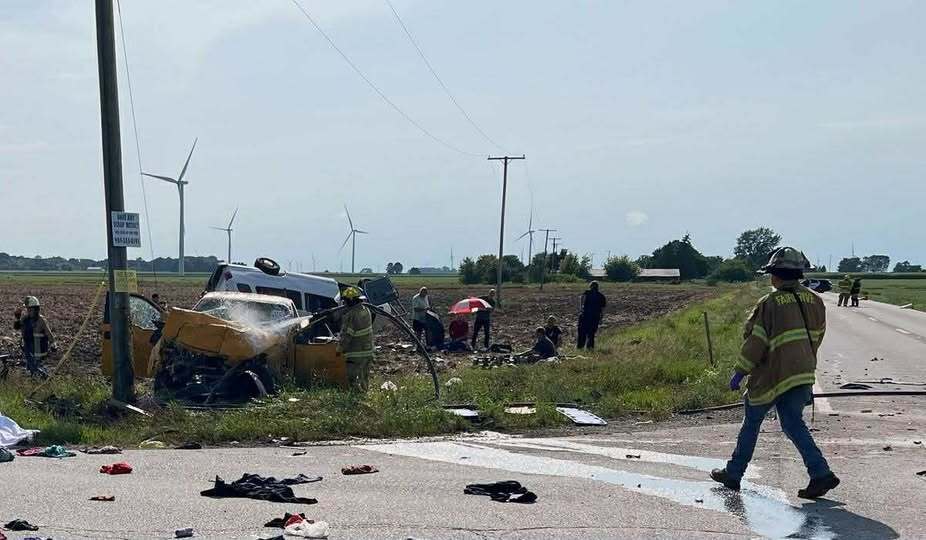
What began as an ordinary night journey along one of Brazil’s most dangerous highways ended in unimaginable tragedy.
On Tuesday night (13), a devastating head-on collision between a van and a truck on BR-251, near the municipality of Grão Mogol, transformed a dark stretch of road into a scene of chaos, heartbreak, and desperation. By the time emergency crews finished pulling victims from the wreckage, nine people had lost their lives and another 12 had been injured.
The crash sent shockwaves across the country.
Images from the accident site quickly spread online, showing twisted metal scattered across the highway, shattered glass reflecting emergency lights, and rescue workers moving frantically through the wreckage in an attempt to save survivors trapped inside the destroyed vehicles. For many Brazilians, the tragedy became yet another painful reminder of the dangers that continue to haunt long-distance travel on federal highways.
But beyond the horrifying visuals lies a deeper story—one involving exhausted workers, dangerous road conditions, unanswered questions, and investigators racing to determine exactly what went wrong.
And according to early findings from investigators, one critical detail may explain why the collision became so catastrophic.
Authorities now believe the truck crossed into the opposite lane moments before impact.
Experts from the Civil Police of Minas Gerais (PCMG) say tire marks, grooves in the asphalt, and drag evidence collected from the road strongly indicate that the truck invaded the lane where the van was traveling.
“It was a determining factor,” forensic expert Hugo Leonardo reportedly stated during the initial analysis.
That conclusion has intensified public outrage and renewed debate over highway safety across Brazil.
Because for the families mourning their loved ones today, the most painful question remains the same:
Could this disaster have been avoided?
A Journey That Never Reached Home
The van involved in the crash was reportedly transporting workers who were returning to the state of Ceará after spending time away for work. For the passengers onboard, the trip was supposed to represent something hopeful: returning home, reuniting with family, and finally resting after long periods on the road.
Instead, the night ended in horror.
Witnesses described hearing an enormous explosion-like impact that echoed across the highway. Drivers traveling nearby reportedly stopped immediately, rushing toward the scene in confusion and panic. What they found was devastating.
The front sections of both vehicles had been almost completely destroyed by the force of the collision.
Survivors trapped inside screamed for help while bystanders attempted to assist before rescue teams arrived. Some reportedly used flashlights from their phones to search through debris in the darkness, trying to locate passengers amid twisted metal and shattered seats.
Emergency responders arriving at the scene were confronted with what many later described as one of the most disturbing highway accidents in recent memory.
Several victims died instantly.
Others suffered severe fractures, traumatic injuries, and internal bleeding. Rescue crews worked through the night to stabilize survivors before transporting them to nearby hospitals.
For many families, the first indication that something had gone terribly wrong came through frantic phone calls, unanswered messages, and social media posts spreading news of the crash.
Within hours, grief had spread far beyond the accident site.
The Highway Known For Tragedy
BR-251 has long carried a grim reputation.
Stretching across parts of southeastern and northeastern Brazil, the highway is considered by many drivers to be one of the country’s most dangerous roads. Narrow lanes, heavy cargo traffic, poor visibility at night, and difficult overtaking conditions have contributed to countless accidents over the years.
Locals often describe certain sections of the road as terrifying after dark.
Truck traffic is constant, and long-distance drivers frequently face exhaustion during overnight travel. Combined with difficult road geometry and inconsistent maintenance, even a small error can quickly turn deadly.
Residents in the region say serious crashes have become disturbingly common.
And every new tragedy sparks the same cycle of anger and mourning.
People demand better enforcement.
Better infrastructure.
Better lighting.
Better inspection of commercial vehicles.
But despite repeated warnings and previous accidents, many believe meaningful improvements still have not arrived quickly enough.
Following Tuesday night’s disaster, social media became flooded with emotional reactions from Brazilians questioning how so many fatal accidents continue happening on major federal highways.
Some users blamed reckless driving.
Others pointed to inadequate road conditions.
Many simply expressed heartbreak for the victims and their families.
One comment that spread widely online read:
“People leave home trying to build a better life and never come back.”
That sentence seemed to capture the emotional weight of the tragedy for many across the country.
The Critical Clue Investigators Found
As rescue operations continued, forensic teams began carefully examining the crash site.
Investigators from the Civil Police of Minas Gerais reportedly analyzed tire marks left on the pavement, the position of debris, impact angles, and damage patterns on both vehicles.
According to the initial findings, evidence strongly suggests that the truck crossed into the lane occupied by the van before the collision occurred.
That detail may ultimately become the central factor in determining responsibility.
Forensic expert Hugo Leonardo explained that physical traces left on the asphalt were essential in reconstructing the sequence of events. Tire marks and grooves helped investigators identify where the vehicles were positioned seconds before impact.
Those marks reportedly indicated that the truck moved into the opposite lane directly into the van’s path.
Head-on collisions are among the deadliest types of traffic accidents because the force of impact becomes multiplied by the speed of both vehicles. When large cargo trucks are involved, survival rates drop dramatically due to the immense weight difference between vehicles.
In this case, authorities believe the impact was so violent that many victims had little chance of survival.
Investigators are now expected to examine several additional factors, including:
- The truck driver’s condition before the crash
- Possible fatigue or sleep deprivation
- Mechanical failures
- Brake system functionality
- Speed at the time of impact
- Road conditions
- Weather and visibility
- Driver distraction
Authorities may also review maintenance records and work schedules connected to the truck.
Because while crossing into the opposite lane appears to have triggered the collision, investigators still need to understand why it happened.
And that distinction could determine whether the crash is ultimately classified as negligence, mechanical failure, or a preventable operational error.
The Human Stories Emerging From The Wreckage
As names and identities of the victims gradually emerged, the tragedy became painfully personal.
Behind every number was a life interrupted.
Friends described victims as hardworking people trying to support their families. Some were reportedly parents of young children. Others had spent years traveling for temporary jobs in different regions of Brazil.
Many passengers onboard the van likely believed they were only hours away from home.
Families waiting in Ceará reportedly became increasingly desperate as information spread through news reports and messaging apps. Hospitals and authorities were overwhelmed with calls from relatives searching for loved ones.
In tragedies like this, the emotional devastation often extends far beyond those directly involved.
Entire communities feel the loss.
Neighbors gather outside homes.
Churches organize vigils.
Photos begin circulating online accompanied by messages of grief and disbelief.
And amid the mourning, survivors are left carrying emotional scars that may last forever.
Those who lived through the collision will likely remember the sound of impact, the screams, the darkness, and the confusion for the rest of their lives.
Trauma specialists frequently note that survivors of catastrophic road accidents experience long-term psychological effects including anxiety, insomnia, depression, and post-traumatic stress.
For families who lost loved ones, grief becomes even more complicated when the deaths appear potentially preventable.
That possibility can transform sadness into anger.
Why Head-On Collisions Are So Deadly
Traffic safety experts often describe head-on crashes as the “perfect storm” of roadway violence.
Unlike side-impact or rear-end collisions, head-on impacts combine the momentum of both vehicles traveling toward one another. The energy released during such collisions is enormous.
When one vehicle is a truck, the consequences become even more severe.
Commercial trucks can weigh many times more than passenger vehicles or vans, meaning smaller vehicles absorb devastating levels of force during impact.
In many cases, the front portions of lighter vehicles collapse almost instantly.
Experts say survival often depends on split-second variables such as:
- Exact angle of collision
- Vehicle speed
- Seatbelt use
- Structural integrity
- Emergency response time
- Position of passengers inside the vehicle
Even modern safety systems may provide limited protection in extremely violent head-on impacts involving heavy cargo transport vehicles.
That reality is one reason transportation authorities worldwide focus heavily on preventing lane invasions and driver fatigue among truck operators.
Many countries have introduced stricter regulations involving mandatory rest periods, electronic monitoring systems, and highway surveillance to reduce fatigue-related accidents.
But enforcement challenges remain significant, especially on long-distance freight routes.
Fatigue: The Invisible Danger On Highways
One of the major questions investigators may explore is whether fatigue played a role in the crash.
Long-haul truck driving is physically and mentally exhausting.
Drivers often spend countless hours on highways under intense pressure to meet delivery schedules. Overnight driving, monotonous roads, lack of sleep, and extended work periods can severely reduce reaction times and decision-making ability.
Studies have repeatedly shown that fatigue can impair drivers in ways similar to alcohol consumption.
A tired driver may drift between lanes, fail to notice hazards, or even briefly fall asleep behind the wheel.
What makes fatigue especially dangerous is how invisible it can be.
A driver may believe they are still alert enough to continue operating the vehicle, even as their concentration deteriorates.
In Brazil and many other countries, truck driver exhaustion has become a recurring topic after major highway tragedies.
Critics argue that economic pressures within the freight industry can indirectly encourage unsafe driving schedules.
Drivers sometimes face difficult choices:
Rest and risk missing deadlines.
Or continue driving while exhausted.
When accidents happen, the consequences can be catastrophic.
Investigators have not yet publicly confirmed whether fatigue contributed to Tuesday night’s crash, but many observers believe the possibility cannot be ignored.
The Emotional Toll On Rescue Teams
While public attention often focuses on victims and investigations, tragedies like this also leave deep emotional impacts on emergency responders.
Firefighters, paramedics, police officers, and forensic experts who arrive at mass casualty scenes are exposed to traumatic situations most people never witness.
Rescue workers reportedly spent hours removing bodies and assisting severely injured survivors after the collision.
In many fatal crashes, responders must work in emotionally overwhelming conditions—comforting victims, managing panic, and making impossible decisions about whom to prioritize first.
Some responders later describe hearing survivors calling out for missing relatives or friends trapped inside wreckage.
Those moments can remain with them permanently.
Psychological support for first responders has become an increasingly important issue worldwide, particularly following large-scale disasters and mass casualty events.
Repeated exposure to traumatic scenes can contribute to burnout, anxiety, and emotional distress among emergency personnel.
Yet despite those challenges, rescue crews continue returning to accident scenes night after night.
For many communities, they are the difference between life and death.
Social Media’s Role In Modern Tragedy
Within minutes of the crash, photos and videos from the highway began circulating online.
In the modern digital era, major accidents no longer remain local events for long. Images spread instantly across messaging platforms, news pages, and social media feeds.
This rapid circulation creates a strange dual reality.
On one hand, it raises awareness quickly and allows families to seek information.
On the other hand, it can intensify trauma.
Relatives sometimes encounter disturbing images online before authorities have officially contacted them. Rumors spread rapidly. Inaccurate information becomes difficult to control.
At the same time, public outrage also grows faster.
Following the BR-251 tragedy, thousands of users expressed frustration over repeated fatal crashes on Brazilian highways. Many demanded stronger enforcement and infrastructure improvements.
Some posts criticized freight transportation practices.
Others called for expanded highway modernization projects.
Many simply mourned the victims.
The emotional reactions reflected something deeper than anger over one single accident.
For many Brazilians, the crash symbolized a larger national problem that has persisted for years.
Highway Safety And The Broader Crisis
Road traffic deaths remain a massive global public safety issue.
According to international transportation studies, millions of people are injured or killed in traffic accidents every year worldwide. Developing regions often face particularly severe challenges due to infrastructure limitations, enforcement gaps, and increasing traffic volume.
Brazil has struggled for decades with high rates of roadway fatalities.
Federal highways connecting distant regions are especially vulnerable because they carry heavy cargo traffic alongside passenger transportation over long distances.
Experts say meaningful improvement requires a combination of factors:
- Better road engineering
- Increased enforcement
- Safer commercial transport policies
- Driver education
- Improved emergency response systems
- Stronger vehicle inspection programs
But implementing those solutions consistently across enormous transportation networks is extremely difficult and expensive.
Following every major tragedy, public attention briefly intensifies.
Then, over time, the headlines fade.
Until the next disaster occurs.
That cycle has become painfully familiar.
Families Waiting For Answers
As investigations continue, grieving families are now facing an agonizing process.
Authorities must complete victim identification procedures, forensic examinations, and formal reporting before many families can fully begin mourning.
Funeral arrangements, transportation of bodies, hospital visits, and legal processes create additional emotional strain during already devastating moments.
For relatives of the injured, uncertainty continues.
Some survivors reportedly remain hospitalized with serious injuries.
Families are now balancing grief for those lost while desperately hoping others recover.
In catastrophic accidents, emotional timelines rarely move neatly.
Shock often comes first.
Then disbelief.
Then anger.
Then sorrow.
And throughout all of it, one question repeats endlessly:
Why?
Why did the truck enter the opposite lane?
Could the driver have avoided it?
Was fatigue involved?
Did mechanical failure occur?
Were warning signs ignored?
Until those questions are answered, closure remains impossible.
Survivors Who Will Never Forget
Among the injured are individuals whose lives may never fully return to normal.
Major traffic accidents can leave survivors with lifelong physical injuries including spinal damage, fractures, mobility limitations, chronic pain, and neurological complications.
But psychological trauma can be equally devastating.
Many crash survivors describe replaying the accident repeatedly in their minds for years afterward.
Some become terrified of driving.
Others struggle with guilt after surviving when others did not.
Mental health professionals sometimes refer to this as “survivor’s guilt”—a painful emotional condition where individuals question why they lived while others died.
Recovery can take months or even years.
And in some cases, emotional wounds never completely disappear.
The Investigation Moving Forward
Authorities are expected to continue analyzing multiple aspects of the crash in the coming days and weeks.
Investigators may examine:
- Vehicle data
- Tachograph records
- Driver histories
- Toxicology results
- Mechanical inspections
- Witness statements
- Highway surveillance footage
- Cargo documentation
These elements help reconstruct the final moments leading up to impact.
Depending on the findings, criminal liability could potentially become part of the investigation.
If negligence, reckless driving, or regulatory violations are identified, legal consequences may follow.
For now, however, officials remain focused on determining the precise sequence of events.
And for the public, every new detail intensifies the emotional weight of the tragedy.
A Country Mourning Yet Again
Brazil has experienced many devastating highway disasters over the years.
But certain tragedies resonate more deeply because they feel painfully relatable.
Workers returning home.
Families waiting for reunions.
Ordinary people simply trying to reach their destination safely.
Those stories remind everyone how fragile life can become in a single moment.
Tuesday night’s collision on BR-251 was not merely a transportation accident.
It became a national moment of grief.
Nine people who expected to continue their lives never made it home.
Twelve others now face long roads to recovery.
And countless relatives are left navigating unimaginable loss.
Across social media, news broadcasts, and conversations around the country, people continue repeating the same heartbreaking sentiment:
No one should die like this.
The Larger Question Nobody Can Ignore
Perhaps the most haunting aspect of tragedies like this is how familiar they feel.
Every major highway disaster sparks outrage, mourning, investigations, and promises of change.
Yet fatal collisions continue happening.
Experts warn about fatigue.
Drivers warn about dangerous roads.
Communities warn about recurring accidents.
Still, the deaths continue.
That reality is why the BR-251 tragedy has struck such a deep emotional nerve.
Because beyond the forensic analysis and headlines lies a fear shared by millions of ordinary people:
That any routine trip could suddenly become fatal.
One wrong movement.
One moment of exhaustion.
One lane crossed.
And entire families are changed forever.
The Final Moments That Changed Everything
Somewhere along that dark highway Tuesday night, two vehicles approached one another from opposite directions.
Inside the van were workers likely thinking about home.
Perhaps some were asleep.
Perhaps others were messaging family members.
Perhaps someone was talking about finally seeing loved ones again after days away.
Then, in seconds, everything ended.
Investigators now believe the truck crossed into their lane.
The impact was immediate.
Violent.
Unforgiving.
Metal crushed inward.
Lives vanished instantly.
And another devastating chapter was added to Brazil’s long history of highway tragedies.
Now forensic experts continue measuring marks in the asphalt, analyzing evidence, and reconstructing the crash piece by piece.
But for grieving families, the most important truth has already become painfully clear.
Nine people are gone.
And no investigation can bring them back.










Leave a Reply