
The annual White House Correspondents’ Association dinner, an event typically defined by high-stakes political satire and high-society networking among the nation’s elite, descended into absolute chaos on Saturday night.
The sudden eruption of gunfire outside the main ballroom forced an immediate and dramatic evacuation of the President, the First Lady, and a significant number of top-tier lawmakers and administration officials, including White House Press Secretary Karoline Leavitt. The incident occurred as the gala was just beginning to toast the Washington press corps, turning the star-studded “nerd prom” into a scene of panic and confusion.
According to police reports and photographic evidence released shortly after the incident, Allen was apprehended in the hotel lobby, shirtless and pinned to the floor by Secret Service agents. He was reportedly armed with a shotgun and multiple knives, having charged toward a security checkpoint in a direct attempt to reach the President’s location.
While the motive remains under investigation, Interim DC Police Chief Jeffrey Carroll confirmed that the suspect appeared to be a “lone actor” and was likely a guest at the hotel, suggesting there was no broader threat to the public following his arrest. The intensity of the confrontation resulted in one Secret Service agent being shot at close range.
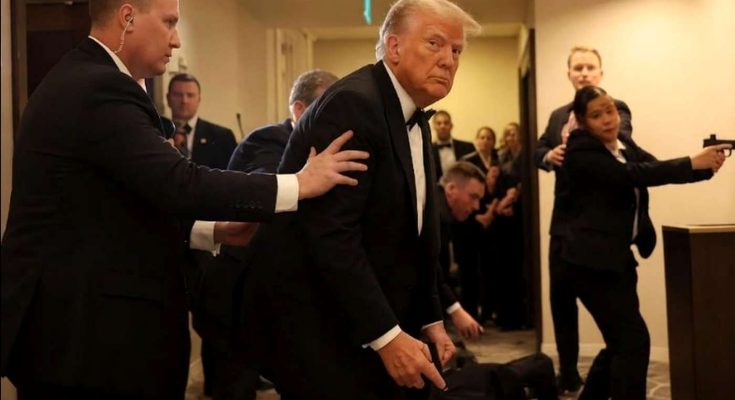
President Trump later noted that the agent was struck by a “very powerful gun,” but fortunately survived the encounter without life threatening injuries due to the protection of a bulletproof vest
The President praised the rapid response of law enforcement, stating they did a “fantastic job” and acted “very quickly” in neutralizing the threat before the situation could escalate further inside the crowded ballroom.
At a subsequent press briefing held only hours after the terrifying events at the Washington Hilton, President Donald Trump addressed the nation with a tone that shifted between anger, disbelief, and reflection. Standing before reporters in a heavily guarded room, the President described the alleged gunman, Cole Allen, as a “sick person,” condemning the violent act that had thrown one of Washington’s most recognizable political gatherings into chaos. Trump also confirmed that federal authorities had already launched an extensive search of the suspect’s residence in California as investigators worked to uncover a motive behind the shocking attack.
The annual White House Correspondents’ Dinner, often referred to as “Nerd Prom,” has long represented a rare evening where politicians, journalists, celebrities, and media executives gather under one roof despite their political differences. But on this night, the traditional atmosphere of humor and rivalry was replaced by panic after gunfire erupted near a security checkpoint outside the ballroom where hundreds of guests had assembled.
According to investigators, Cole Tomas Allen allegedly stormed through a security area armed with multiple weapons, including a shotgun, while President Trump, members of his administration, journalists, and invited guests were already seated inside the ballroom. Secret Service agents reacted within seconds, exchanging gunfire and rushing to shield attendees from danger. One officer was reportedly struck in the ballistic vest during the confrontation but survived without life-threatening injuries.
As confusion spread throughout the hotel, guests described hearing loud bangs echo through the hallways before Secret Service agents suddenly ordered everyone to evacuate or take cover. Some attendees hid inside bathrooms and service corridors, while others were pushed to the ground by security personnel attempting to secure the scene. Witnesses later recalled the terrifying uncertainty of not knowing whether there were additional shooters or whether the President himself had been targeted directly.
Despite the fear that consumed the building, President Trump later focused much of his remarks on what he viewed as an extraordinary moment of unity that emerged from the crisis. Speaking to reporters, he reflected on the atmosphere inside the ballroom just before and after the evacuation, describing a surprising sense of togetherness among journalists, political figures, staff members, and guests.
He explained that the White House Correspondents’ Dinner is fundamentally tied to the principle of freedom of speech — a celebration of the relationship, and often tension, between the presidency and the press. Yet during those frightening moments, Trump said the divisions that normally dominate Washington politics seemed to disappear entirely.
According to the President, people from opposing political parties, rival media organizations, and different ideological backgrounds suddenly found themselves united by a shared instinct to protect one another and survive the unfolding crisis together. He described seeing journalists helping elderly attendees evacuate, political rivals checking on each other’s safety, and staff members guiding strangers toward exits amid the confusion.
Trump called the scene “very beautiful” despite the surrounding terror, saying the collective response demonstrated resilience and humanity in a moment when fear could easily have caused complete disorder. He expressed pride in how attendees handled the emergency, noting that people remained calmer than expected while Secret Service and law enforcement secured the building.
“It brought everybody together,” Trump reportedly said during the briefing. “The press, Republicans, Democrats — everybody was helping everybody. In a strange way, it showed something good about this country during a very dark moment.”
The President’s comments marked a rare moment of praise directed toward members of the press corps, with whom he has frequently maintained a confrontational relationship throughout his political career. For years, the White House Correspondents’ Dinner has symbolized that complicated relationship, often featuring jokes and criticism aimed at both political leaders and journalists alike. Yet the shooting appeared to temporarily suspend those tensions.
Initially, organizers and some officials inside the ballroom reportedly hoped the evening could continue after the immediate threat had been neutralized. In the early minutes following the evacuation, uncertainty surrounded whether the dinner would resume once authorities completed a sweep of the hotel.
President Trump later revealed that he personally pushed to continue the event, insisting that fear should not triumph over democratic traditions or intimidate those gathered there. He admitted that he had prepared what he described as a particularly sharp and memorable speech targeting the media and had “fought like hell” to deliver it despite the disruption.
However, by approximately 9:45 p.m., organizers officially announced that the remainder of the gala had been canceled. Guests were instructed to leave the premises while investigators secured the scene and emergency personnel continued their response.
The cancellation marked an unprecedented moment in the history of the White House Correspondents’ Dinner, an event that has endured wars, political scandals, and decades of national tension without ever experiencing a violent disruption of this magnitude. Many longtime attendees described the incident as surreal, noting that the evening had transformed from a glamorous political tradition into a full-scale security emergency within seconds.
Federal investigators later revealed that Allen had allegedly planned the attack in advance, traveling from California to Washington while carrying firearms, ammunition, and knives. Authorities also stated that the suspect had reportedly monitored the President’s movements before the event and reserved accommodations at the Washington Hilton ahead of time.
The incident has since triggered serious questions regarding security procedures surrounding major political gatherings in Washington, D.C. Although the Washington Hilton stated that it had been operating under Secret Service-approved security protocols, critics argued that the breach exposed vulnerabilities in one of the nation’s most heavily protected public events.
Security experts have pointed specifically to the layered checkpoint system inside the hotel, where attendees passed through different screening areas before reaching the ballroom. Investigators are now examining exactly how the suspect managed to move so close to high-profile officials while armed.
The violent disruption has already been described by analysts as one of the most significant security breaches at a major political gathering in recent Washington history. Beyond the immediate investigation, officials are expected to conduct a broad review of safety measures used during future events involving presidents, journalists, and government leaders.
Meanwhile, discussions are reportedly underway to reschedule the White House Correspondents’ Dinner within the next 30 days, though organizers may pursue a smaller or differently structured event following the trauma of the shooting.
For many who attended that night, however, the memory of the chaos will likely overshadow the glamour and symbolism traditionally associated with the gala. What began as an evening dedicated to journalism, politics, and public discourse instead became a stark reminder of the growing dangers surrounding political life in America.
Yet amid the fear, evacuation alarms, and armed response teams, many attendees also remembered something else: strangers helping strangers, rivals standing side by side, and a room filled with people who — at least for one terrifying moment — forgot politics entirely and simply tried to protect one another.




Leave a Reply