
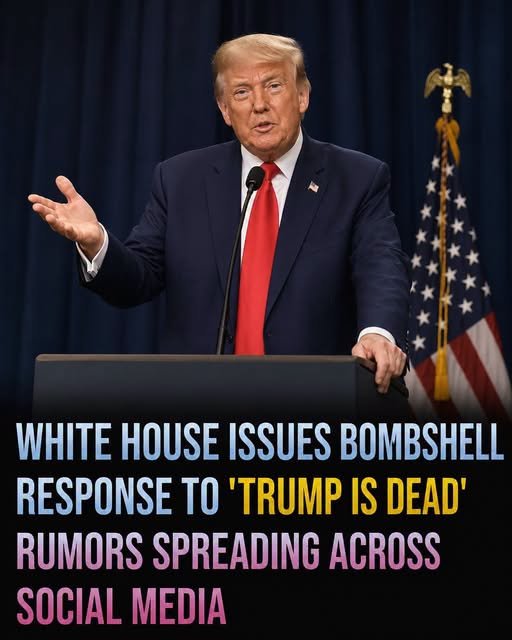
The internet went into meltdown within minutes.
A single White House announcement—and suddenly half the country seemed convinced Donald Trump was dead. There was no evidence. No official confirmation. No medical statement. No photograph, no emergency announcement, and no credible report establishing that anything had happened to the president. There was simply a time, a podium, and a vice president stepping forward to brief the press.
But on an internet where uncertainty can become certainty in seconds, that was apparently enough.
The announcement spread across social media, and speculation immediately filled the empty spaces. What was the vice president going to say? Why was the briefing happening? Was something being hidden? Was there an emergency behind closed doors? Before anyone had reliable answers, users were already creating their own.
Then the fake “breaking news” posts began appearing.
One account would make a claim. Another would repost it. A third would add an alarming headline. Screenshots circulated without context, comments were treated as evidence, and speculation was repeated so many times that some people began assuming it had to be true. The rumor moved faster than verification could keep up.
Within minutes, an ordinary political announcement had become something much larger.
What actually happened was far less dramatic than the fever dream unfolding online, but the reaction revealed something raw and unsettling about the modern information environment. A routine notice that Vice President JD Vance would brief the press became a Rorschach test for a nation already accustomed to political drama, crisis headlines, conspiracy theories, and nonstop breaking-news alerts.
Others expressed disbelief that anyone could believe such a claim without evidence.
And many simply accepted whatever appeared first on their screens.
That may have been the most disturbing part.
The rumor did not need proof to gain momentum. It only needed uncertainty.
In an environment where people scroll through hundreds of headlines every day, the first version of a story can become the version people remember—even when it is completely wrong. A dramatic claim attracts attention. Attention creates engagement. Engagement pushes the claim toward more people. And suddenly something that began as an unsupported post can look like a major national event.
The mechanics are almost frighteningly simple.
By the time anyone asks for evidence, thousands or millions of people may already have seen it.
The White House eventually hit back hard, denouncing those pushing baseless claims that Trump had died and insisting that the president remained sharp, energetic, and firmly in control. The response attempted to cut through the speculation and return the conversation to reality.
But by then, the rumor had already accomplished what viral misinformation often does best: it had created an emotional reaction before the facts arrived.
For a brief period, people were not responding to something that had happened.
They were responding to something they believed might have happened.
In a deeply polarized country, information about a president can carry enormous emotional weight. Supporters may immediately fear that something has happened to their leader. Opponents may react with celebration or disbelief. Others may simply become curious and begin sharing the story to ask whether it is true.
But every share, even one asking “Is this real?”, can help propel a rumor further.
And political rumors are especially powerful because they do not exist in a vacuum. They arrive in an atmosphere already saturated with suspicion. People have become accustomed to questioning institutions, journalists, government statements, political opponents, and even information coming from their own side.
Another trusts a screenshot from a stranger.
Another trusts whatever appears to be trending.
And when everyone has a different source of truth, even a simple announcement can become a battlefield.
The episode also demonstrated how quickly the boundaries between satire, speculation, misinformation, and genuine reporting can disappear online. A joke may be created as obvious satire, only to be reposted by someone who takes it seriously. A fabricated screenshot may look convincing enough to fool someone who encounters it without the original context. A headline can be altered, cropped, or stripped of its source until its connection to reality becomes almost impossible to trace.
For ordinary users, that creates a difficult responsibility.
The most important question is often not, “How shocking is this?”
In this case, the answer to that question mattered more than the rumor itself.
The absence of evidence was not a minor detail.
Yet millions had already watched a rumor become a temporary reality inside their feeds.
For others, long enough to provoke fear, celebration, anger, or arguments with friends and strangers.
The internet moved on to the next headline.
A country so politically divided, suspicious, and constantly connected can become extraordinarily vulnerable to information that fills uncertainty with fear. When every unusual announcement is interpreted as a potential crisis, people can end up experiencing events that never actually occurred.
The episode was therefore not really about a president’s health.
It was about the power of ambiguity in the age of instant information.
It was about how quickly people can transform a question into an assumption, an assumption into a rumor, and a rumor into something that feels real.
The White House announcement itself was ordinary.
And perhaps that is the most unsettling lesson of all: in a world where everyone carries a news feed in their pocket, reality can sometimes lose the race against the rumor.
By the time the truth arrives, millions may already have lived through the false version of the story.
For a few chaotic minutes, an unsupported claim managed to make people believe the world had changed overnight.
But the reaction showed just how easily it could have felt that way.










Leave a Reply