
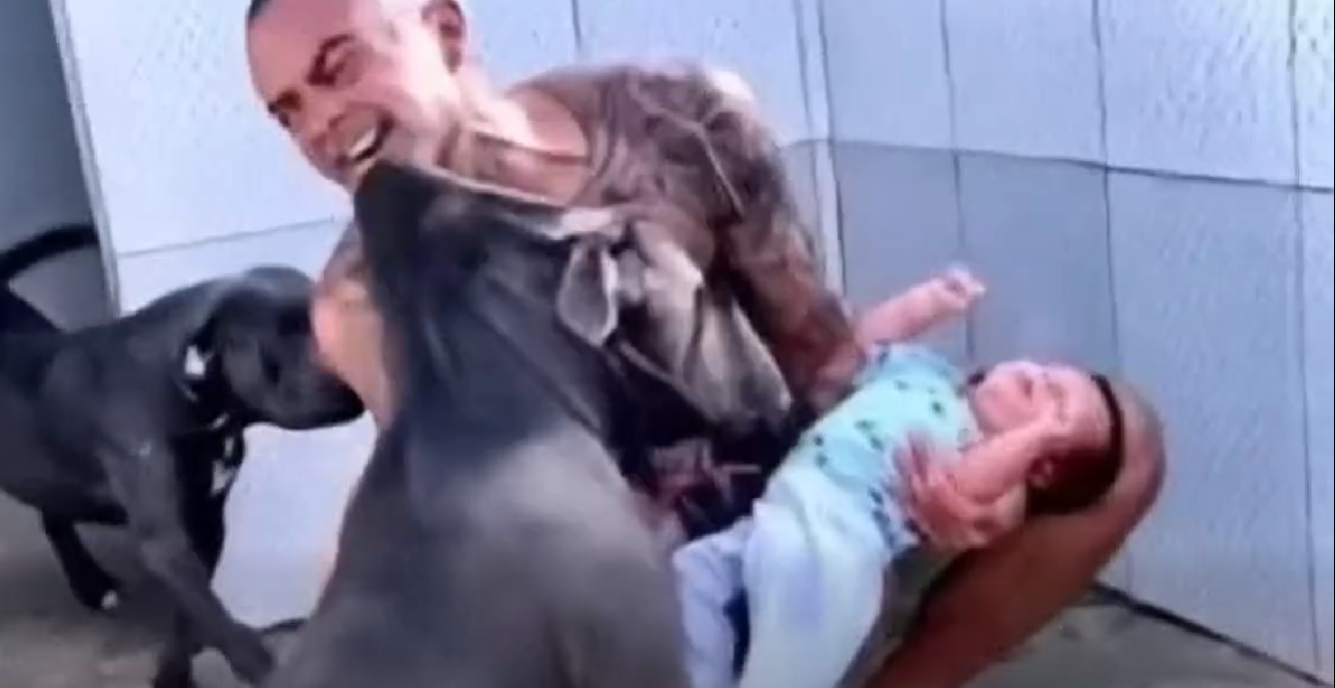
A terrifying incident involving a family pit bull has left people online stunned after the dog suddenly turned on its owner’s son, creating a chaotic scene that nobody in the household expected.
What began as an ordinary moment inside the home quickly became a frightening situation when the powerful dog reportedly became aggressive toward the young man. Within seconds, what appeared to be a normal interaction had turned into a desperate struggle, with family members forced to react immediately.
The incident has since sparked a huge discussion online about dogs, responsible ownership, and the importance of understanding an animal’s behavior before something goes wrong.
According to the account being shared online, the dog had been part of the household and was familiar with the family. That is one of the reasons the alleged attack was so shocking.
People often assume that a dog they have known for years could never seriously hurt someone in the family. But animal behavior can be unpredictable, and even dogs that appear calm and affectionate can react unexpectedly under certain circumstances.
The situation reportedly unfolded suddenly.
The owner’s son was near the dog when the animal became agitated. What happened next was described as an attack, leaving those nearby scrambling to intervene.
The exact circumstances surrounding the incident remain important, because aggressive behavior can have many possible triggers. Fear, pain, stress, territorial behavior, resource guarding, overstimulation or an interaction that the dog interpreted incorrectly can all play a role in a sudden change in behavior.
And when a large, powerful dog reacts aggressively, even a few seconds can feel like an eternity.
Family members reportedly tried to separate the dog from the young man while attempting to prevent the situation from becoming even more dangerous.
The terrifying moment has led many people to ask the same question:
How could a dog living with a family suddenly attack someone it knew?
The answer isn’t always simple.
Dogs don’t necessarily view human relationships in the same way people do. A dog can be affectionate toward members of a household while still displaying behaviors that require careful management. Previous calm behavior also does not guarantee that an animal will never become aggressive.
That is why experts repeatedly emphasize responsible ownership, supervision and paying attention to warning signs.
Growling, stiff body language, freezing, showing teeth, intense staring, guarding food or toys, snapping, avoiding contact or suddenly becoming unusually reactive can all be signals that an owner should take seriously.
Ignoring those behaviors can allow a problem to become more serious.
One of the biggest misconceptions surrounding dog attacks is that they always happen completely “out of nowhere.”
Sometimes there are warning signs that people simply don’t recognize.
Other times, however, an animal may be dealing with pain, illness, fear or another underlying problem that isn’t immediately obvious. That’s why a sudden behavioral change should never simply be dismissed.
A veterinarian can help determine whether a medical issue may be contributing to unusual aggression, while a qualified behavior professional can help assess the animal and recommend appropriate steps.
The incident has also reignited a heated debate surrounding pit bulls and similar powerful breeds.
Some commenters immediately blamed the breed, arguing that powerful dogs should never be kept around children or inexperienced owners.
Others pushed back, saying that focusing entirely on the breed ignores the role of training, socialization, environment and responsible ownership.
The debate quickly became emotional.
One side argued that the physical strength of certain dogs means owners must take extra precautions. The other side pointed out that individual behavior varies dramatically between dogs and that responsible handling matters regardless of breed.
But there is one point both sides can agree on:
A dog capable of causing serious injury must always be treated with respect and caution.
For families living with powerful dogs, safety should never depend on assumptions such as “he’s always been friendly” or “she would never hurt us.”
Children should be taught not to disturb dogs while they are eating, sleeping or caring for puppies. Dogs should have a safe space where they can retreat without being bothered. Food, toys and other possessions that a dog may guard should be managed carefully.
And adults should never leave young children unsupervised with a dog, regardless of how familiar or trusted the animal may be.
The aftermath of an incident like this can also be extremely difficult for a family.
There may be physical injuries, emotional trauma and difficult decisions about what should happen next. The owner may feel devastated because the animal is not simply a pet—it may have been part of the family for years.
At the same time, protecting people must come first.
If a dog has seriously injured someone, owners should seek professional guidance rather than attempting to handle the situation alone. Depending on the circumstances, authorities, animal-control professionals, veterinarians and qualified behavior specialists may need to become involved.
And if someone has been bitten, medical attention should be considered immediately, particularly when wounds are deep, bleeding heavily, located on the face or hands, or show signs of infection.
The story has also served as a reminder that social-media videos and viral posts rarely tell the complete story.
A short clip or dramatic caption can make an incident appear straightforward, while the actual circumstances may be far more complicated.
That is why people should be cautious before reaching conclusions about the dog, the owner or the person involved without verified information.
Still, the emotional reaction online is understandable.
Seeing a family member attacked by an animal that was believed to be a trusted companion is deeply disturbing.
For some viewers, the incident is a warning about taking dog behavior seriously. For others, it raises questions about how families should evaluate the risks associated with powerful animals.
And for dog owners everywhere, perhaps the biggest lesson is a simple one:
Never ignore a change in your dog’s behavior.
A dog doesn’t need to be aggressive all the time to present a serious risk. Small changes can sometimes be the first indication that something isn’t right.
Owners should learn their dog’s body language, avoid forcing interactions, supervise children carefully and seek professional help when concerning behavior appears.
Most importantly, people should remember that responsible dog ownership isn’t only about loving an animal.
It’s also about understanding it.
It’s about recognizing that a dog is an animal with instincts, emotions and physical capabilities that humans cannot always predict perfectly.
The heartbreaking reality is that even an animal that has spent years sleeping beside the family can behave differently in a stressful situation.
That’s why preparation matters.
That’s why supervision matters.
And that’s why warning signs should never be ignored.
As the story continues to circulate, people are left with the same chilling thought: the situation could have ended very differently.
What happened next remains the part of the story that has captured the attention of thousands of viewers, with many rushing to the comments to discuss what they believe should happen to the dog and how families can prevent similar incidents.
The debate will likely continue.
But beyond the arguments about breed, ownership and responsibility, one message stands above everything else:
When an animal shows signs of aggression, take it seriously.
Don’t assume it was “just a bad moment.”
Don’t assume it can never happen again.
And never put someone’s safety at risk because you believe a familiar dog could never turn dangerous.
For the family involved, the incident is far more than a viral story. It is a frightening reminder of how quickly an ordinary moment can change—and how important it is for every dog owner to understand the responsibility that comes with keeping a powerful animal in the home.











Leave a Reply