
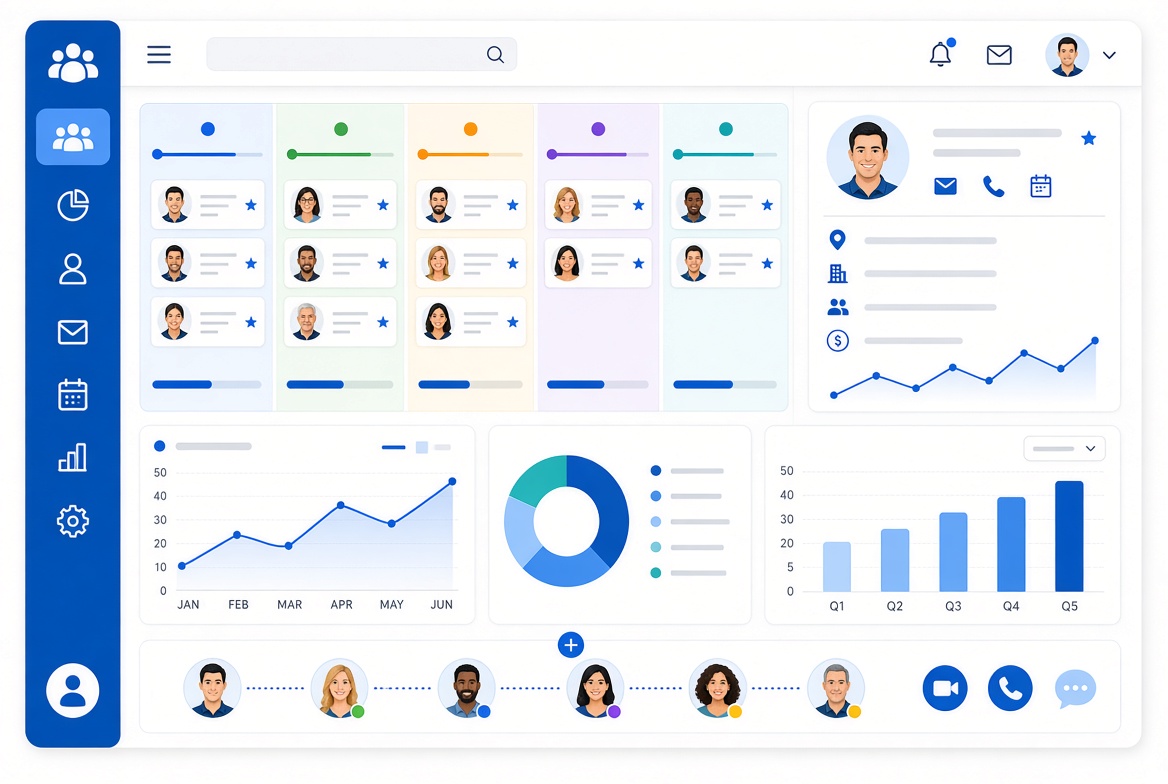
In today’s competitive market, companies that understand their customers win. A Customer Relationship Management (CRM) system is no longer just a contact database — it has become the central nervous system of sales, marketing, and customer success teams.
This guide explains what a CRM really is, why high-performing companies invest heavily in it, and how the right system can dramatically improve revenue, customer retention, and operational efficiency.
A CRM (Customer Relationship Management) system is a technology platform that helps businesses manage all interactions and data related to current and potential customers. It consolidates customer information into a single, organized database so teams can work more efficiently and deliver better experiences.
When used correctly, a CRM becomes the single source of truth for every customer-facing department.
Customer expectations have increased significantly. People expect personalized communication, fast responses, and consistent experiences across every channel. Companies that still rely on spreadsheets or disconnected tools struggle to keep up.
Organizations that implement a strong CRM strategy usually see improvements in:
According to multiple industry studies, companies using CRM systems effectively can increase sales by up to 29% and improve customer retention by more than 25%.
Not all CRM platforms are equal. The best systems share several critical capabilities:
1. Centralized Customer Data All information — emails, calls, meetings, purchases, and support tickets — lives in one place. This eliminates data silos and gives every team member full context.
2. Sales Pipeline Visibility A clear visual pipeline allows managers to forecast revenue accurately and identify bottlenecks early.
3. Automation Repetitive tasks such as follow-up emails, lead assignment, and data entry can be automated, freeing sales representatives to focus on closing deals.
4. Advanced Reporting Real-time dashboards help leadership understand what is working and where resources should be allocated.
5. Seamless Integrations The CRM should connect easily with email platforms, calendars, marketing tools, accounting software, and customer support systems.
Sales teams benefit the most from a well-implemented CRM. Here’s how:
Better lead management : Leads are scored, prioritized, and assigned automatically.
: Leads are scored, prioritized, and assigned automatically. Consistent follow-up : Automated reminders prevent deals from falling through the cracks.
: Automated reminders prevent deals from falling through the cracks. Improved forecasting : Managers can predict revenue with much higher accuracy.
: Managers can predict revenue with much higher accuracy. Shorter sales cycles: With full customer history available, representatives close deals faster.
Companies that treat their CRM as a strategic asset rather than just a database consistently outperform competitors.
One of the biggest advantages of modern CRM platforms is the ability to align sales and marketing teams. When both departments work from the same data:
Marketing can create more targeted campaigns
Both teams measure performance using the same metrics
This alignment reduces friction and increases overall revenue efficiency.
Selecting a CRM depends on several factors:
Popular enterprise solutions include Salesforce, HubSpot, Microsoft Dynamics 365, and Zoho CRM. Each has strengths depending on the organization’s needs.
The most important rule is simple: the best CRM is the one your team will actually use every day.
Many companies fail to get results from their CRM because of poor implementation. The most frequent mistakes include:
Lack of clear processes before implementing the tool
Over-customization that makes the system complicated
Treating the CRM as optional instead of mandatory
Successful CRM adoption requires leadership support, clear processes, and continuous optimization.
Artificial intelligence is rapidly changing CRM platforms. Modern systems now offer:
Personalized customer journey recommendations
In the coming years, CRM platforms will become even more proactive, helping teams anticipate customer needs before they arise.
A CRM system is one of the highest-ROI investments a growing company can make. When implemented correctly, it improves efficiency, increases revenue, and creates better customer experiences.
Businesses that treat customer data as a strategic asset and build their processes around a solid CRM platform are the ones that scale successfully.
Whether you are a small business just starting or an enterprise looking to optimize operations, choosing and properly using a CRM can become a major competitive advantage.











Leave a Reply