
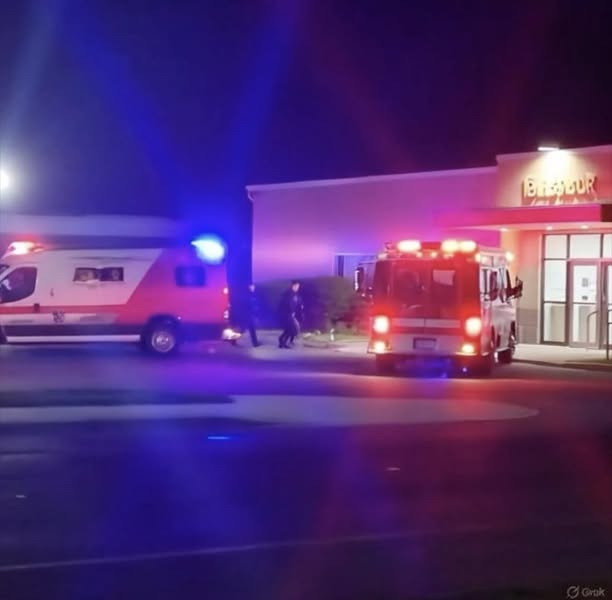
Thousands gathered at the Route 91 Harvest festival, a popular country music event held on the Las Vegas Strip. The atmosphere was vibrant—fans singing along, lights flashing, and artists performing under the desert sky. But at 10:05 p.m., the mood shifted instantly.
From the 32nd floor of the Mandalay Bay, gunman Stephen Paddock opened fire on the crowd below. What initially sounded like fireworks quickly revealed itself as automatic gunfire. Panic spread within seconds. Concertgoers dropped to the ground, scrambled for cover, or ran for their lives as bullets rained down indiscriminately.
The attack lasted approximately 10 minutes, though for those caught in it, it felt far longer. Survivors later described the horrifying confusion—people shielding strangers, friends searching for one another, and the deafening echo of gunfire bouncing off nearby buildings. First responders rushed into the danger, navigating a scene of mass casualties and fear.
By the end of the night, 60 people had been killed, and over 800 were injured, making it the deadliest mass shooting in modern U.S. history. Hospitals across Las Vegas were overwhelmed but responded with urgency and coordination. Doctors, nurses, and volunteers worked tirelessly through the night, while citizens lined up to donate blood and offer help.
Authorities tracked the source of the gunfire to Paddock’s hotel room. When police breached the room, they found he had taken his own life. Inside, investigators discovered an arsenal of firearms, ammunition, and equipment carefully set up to maximize destruction.
In the days and weeks that followed, the nation struggled to comprehend the scale of the tragedy. Vigils were held across the country. In Las Vegas, thousands gathered to mourn, lighting candles and sharing stories of those lost. The city, known for entertainment and spectacle, became a symbol of grief—and resilience.
The aftermath also sparked renewed debates over gun laws, public safety, and how such an attack could occur without warning. Despite extensive investigations, many questions about Paddock’s motives remain unanswered, adding a chilling layer of uncertainty to an already devastating event
The Night That Echoes: Memory, Resilience, and the Lasting Impact of Las Vegas
Years later, the impact of that night continues to ripple outward in ways that are both deeply personal and profoundly collective. What happened did not end when the noise faded, when the crowds dispersed, or when the headlines moved on. Instead, it settled into the lives of survivors, families, and an entire nation—embedding itself in memory, in routine, and in the quiet spaces where reflection often lives.
For those who were there, the experience did not remain in the past. It follows them in ways that are sometimes subtle and sometimes overwhelming. The body may move forward in time, but the mind often returns to moments it cannot fully process. Memory does not always follow logic. It does not ask permission before resurfacing. It arrives in fragments—sounds, flashes, sensations—that carry the weight of what was once real.
A sudden noise can feel different.
A crowded space can feel unfamiliar.
Even silence can carry meaning.
Some survivors still remember the exact sequence of events, while others recall only pieces—disconnected but powerful. For many, the uncertainty of that night has transformed into a heightened awareness of their surroundings. It is not always fear, but it is not the same ease they once knew.
There are those who carry physical reminders—injuries that changed the course of their daily lives. Recovery for them was not just about survival, but adaptation. Learning to walk again. Learning to move without pain. Learning to accept a version of life that feels different from before.
But beyond the physical, there are the invisible wounds.
The kind that do not appear in photographs or reports.
The kind that exist quietly, shaping thoughts, reactions, and emotions.
Sleepless nights.
Unexpected anxiety.
A sense of alertness that never fully fades.
For some, healing has meant seeking support—through therapy, through community, through connection with others who understand. For others, it has meant finding personal ways to cope, to process, to rebuild a sense of stability.
There is no single path.
No universal timeline.
Only individual journeys shaped by experience.
Families of those who lost loved ones face a different kind of reality—one defined not by survival, but by absence. The kind of absence that does not lessen with time, but instead becomes part of the structure of everyday life.
There are moments when it feels most present.
A birthday that arrives without the person it was meant for.
A holiday where one voice is missing.
An ordinary day that suddenly feels heavier without explanation.
Grief does not move in straight lines. It shifts. It evolves. It becomes something that is carried rather than something that passes. For many families, remembering becomes both a source of comfort and a source of pain.
They remember the details.
The small habits.
The conversations that once felt ordinary.
Because those details are what keep a person present, even in their absence.
There is a strong desire to ensure that the lives lost are not reduced to numbers. Each person had a story—relationships, goals, experiences that mattered. Remembering those stories is a way of preserving meaning in the face of something that feels senseless.
Photos are revisited.
Voicemails are replayed.
Messages are read again and again.
These small acts of remembrance create a bridge between past and present. They keep connection alive, even when physical presence is gone.
And yet, alongside the grief, there are also moments of reflection that reveal something else.
Something powerful.
Something human.
In the midst of chaos, there were acts of courage that continue to stand out years later. These were not moments planned in advance. They were decisions made in seconds, driven by instinct and empathy.
Strangers became protectors.
People who had never met before found themselves connected by circumstance, making choices that placed others before themselves. Some guided people to safety, using whatever knowledge they had of the environment. Others stayed behind to help those who could not move on their own.
There were individuals who carried the injured.
Those who returned to dangerous areas because they believed someone else needed help.
Those who refused to leave until they were certain others were safe.
These actions were not performed for recognition. They were not calculated. They were immediate responses to a situation that demanded humanity at its highest level.
In many ways, these moments of courage have become just as important as the tragedy itself. They serve as reminders that even in the darkest situations, people are capable of extraordinary compassion.
They remind us that fear does not always lead to retreat.
Sometimes, it leads to action.
Medical teams and first responders also played a critical role. Their experience that night extended far beyond technical skill. It required emotional strength, endurance, and the ability to function under extreme pressure.
Paramedics moved quickly, making rapid assessments, prioritizing care, and transporting patients as efficiently as possible. In hospitals, doctors and nurses worked continuously, often without rest, focused entirely on saving lives.
The environment was intense.
Decisions had to be made quickly.
There was no room for hesitation.
And yet, through that intensity, there was also compassion.
A recognition that behind every injury was a person.
Behind every emergency was a life that mattered.
For many first responders, the experience did not end when their shift was over. Like survivors, they carried what they had seen. The emotional weight of responding to such an event became part of their own journey—one that required processing, support, and time.
Some found it difficult to return to routine immediately.
Others threw themselves into their work, using action as a way to cope.
But all were affected in ways that extended beyond the moment itself.
Beyond those directly involved, the wider community responded in ways that reflected unity rather than division. In the immediate aftermath, there was a collective movement toward support.
People showed up.
They gathered in shared spaces.
They stood together in silence.
Vigils became places of connection, where individuals could come together not only to mourn, but to feel less alone. Candles were lit. Names were spoken. There was a shared understanding that something significant had happened—something that required collective acknowledgment.
Acts of support extended beyond symbolic gestures.
People donated blood.
They offered financial assistance.
They provided resources to those affected.
Some opened their homes to strangers.
Others volunteered their time.
Each action, no matter how small, contributed to a larger sense of solidarity. It reinforced the idea that even in the face of tragedy, people are capable of coming together with compassion and purpose.
In workplaces, conversations changed.
In schools, discussions took on new meaning.
In homes, families spoke about safety, about awareness, about the unpredictability of life.
These shifts were subtle, but significant.
They reflected a broader impact—one that extended beyond those directly involved.
As time passed, the nature of that support evolved. Immediate response gave way to long-term reflection. Conversations began to take shape—about safety, about awareness, about how to better prevent and respond to similar events in the future.
These conversations are complex.
They involve different perspectives, different experiences, and different ideas about what solutions might look like.
But they are necessary.
Because understanding is part of prevention.
And reflection is part of growth.
For some individuals, the aftermath has become a space for advocacy. They have chosen to use their experiences to raise awareness, to contribute to discussions, and to work toward change. Their voices add depth to the conversation, grounding it in lived experience rather than abstract ideas.
They speak at events.
They share their stories publicly.
They engage in efforts designed to create safer environments.
Their motivation is not only personal, but collective.
They want to ensure that what happened is not forgotten—and that it leads to something meaningful.
For others, the focus has remained more personal.
Honoring memory.
Maintaining connection.
Finding ways to move forward while still holding onto what was lost.
Some create traditions to remember loved ones.
Others support causes in their name.
Some simply carry their memory quietly, in the way they live their daily lives.
There is no single way to respond.
No right or wrong path.
Only choices shaped by individual needs and perspectives.
The event itself, while rooted in a specific moment, has come to represent something broader. It is not only about what happened, but about what it revealed.
It revealed how quickly normal life can be disrupted.
How fragile a sense of safety can be.
How interconnected people are, even in moments of uncertainty.
It also revealed the importance of preparedness, awareness, and support systems. These are not abstract concepts. They are practical considerations that can shape outcomes in critical moments.
At the same time, it is important to recognize the limitations of analysis. No amount of explanation can fully capture the human impact of what occurred. Data and timelines provide structure, but they do not convey experience.
Experience is personal.
It is emotional.
It is complex.
Behind every number is a person.
A life with meaning.
A presence that mattered.
Remembering that is essential.
Because it shifts the focus from the scale of the event to the depth of its impact.
For survivors, for families, and for the community, resilience has become a central theme. Not resilience as a simple concept, but as a lived experience—one that involves pain, adaptation, and growth.
Resilience does not mean forgetting.
It does not mean moving on without acknowledgment.
It means continuing forward while carrying what cannot be left behind.
It means finding ways to rebuild.
To reconnect.
To create meaning in the aftermath of something difficult.
Some have found that meaning in helping others.
In sharing their stories.
In contributing to a broader understanding.
Others have found it in quieter ways.
Through personal reflection.
Through relationships.
Through everyday actions that represent continuity.
There are also those who continue to struggle.
For whom the weight of memory remains heavy.
For whom healing feels distant or incomplete.
Their experiences are just as valid.
Just as important.
Because resilience does not look the same for everyone.
And acknowledging that is part of understanding the full impact of what happened.
The legacy of that night is not fixed. It continues to evolve as time passes, as new perspectives emerge, and as individuals find their own ways of processing what happened.
It lives on in memory.
In conversation.
In the choices people make moving forward.
It also lives on in the small, often unnoticed moments.
A pause in a conversation.
A glance at a familiar place.
A memory that surfaces unexpectedly.
These moments do not demand attention, but they carry meaning.
They are reminders of what was.
Of what changed.
Of what continues to matter.
In many ways, the most lasting impact is not found in the immediate aftermath, but in the long-term effects—the way people think, the way they connect, the way they approach life after experiencing something so sudden and profound.
There is a greater awareness.
A deeper appreciation for time.
A recognition that ordinary moments are not guaranteed.
That presence matters.
That connection matters.
That life, in all its simplicity and complexity, is fragile.
And yet, within that fragility, there is also strength.
A capacity to endure.
To adapt.
To continue.
Years later, the impact remains.
Not always visible.
Not always spoken.
But present.
And in that presence, there is both weight and meaning.
A recognition of vulnerability.
A testament to resilience.
An ongoing reminder of the importance of connection, awareness, and compassion.
Because while that night cannot be changed, its legacy continues to shape how people think, how they respond, and how they value the lives around them.
It serves as a reminder that life is not guaranteed.
That ordinary moments are not insignificant.
That presence matters.
And that loss, when it comes suddenly, leaves an imprint that cannot be ignored.
But within that reality, there is also something else.
A quiet strength.
A collective understanding.
A commitment—spoken or unspoken—to carry forward not only the memory of what was lost, but the lessons of what was revealed.
That commitment lives in actions.
In conversations.
In the way people choose to treat one another.
And in the belief that even in the face of something deeply unsettling, there is still space for humanity, for connection, and for meaning.
Because in the end, it is not only the event itself that defines its legacy.
It is what people do with it afterward.
How they remember.
How they respond.
How they move forward.
And how they ensure that, even in loss, something lasting and meaningful remains.
And as the years continue to pass, that question remains quietly present:
How do we honor what happened without being defined by it?
For some, the answer lies in remembrance.
For others, in action.
For many, it is a combination of both.
It is found in the balance between holding onto the past and continuing toward the future.
It is found in the decision to live with awareness, with compassion, and with intention.
Because while the night itself cannot be undone, its impact can still shape something meaningful.
Something that extends beyond loss.
Something that reflects not only what was taken, but what remains.
And what remains is this:
Memory.
Connection.
Resilience.
And the enduring value of every human life.
But even beyond memory, there is something else that continues to grow with time—perspective.
In the years that follow an event like this, people begin to see it not only as a moment of loss, but as a turning point in how they understand the world. Priorities shift. What once seemed urgent may no longer hold the same weight, while small, everyday moments begin to carry deeper meaning.
A simple conversation.
A shared meal.
A quiet evening at home.
These moments, often overlooked in the rush of daily life, begin to feel more significant. They are no longer just routine—they are reminders of presence, of connection, of time that is not guaranteed.
For many survivors and families, this shift in perspective becomes part of the legacy itself. It influences decisions, relationships, and the way they approach the future. Some choose to live more intentionally, focusing on what truly matters. Others become more connected to their communities, recognizing the importance of support and shared experience.
There is also a growing awareness of the importance of mental and emotional well-being. Conversations that may have once been avoided become more open. People begin to speak more honestly about trauma, about healing, and about the challenges that come with both.
This openness, while born from tragedy, creates space for understanding.
It allows others to learn.
To empathize.
To connect.
And in that connection, there is strength.
The legacy of that night is not only found in what was lost, but in what continues to be built in its aftermath. It exists in the efforts to create safer environments, in the willingness to have difficult conversations, and in the commitment to support those who continue to be affected.
It also exists in the quiet determination of individuals who choose to keep going, even when it is difficult.
Who choose to find meaning, even when answers are incomplete.
Who choose to remember, not only with sadness, but with purpose.
Because memory, when carried forward with intention, becomes more than a reflection of the past.
It becomes a guide for the future.
A reminder of what matters.
A call to act with awareness, with compassion, and with care.
And so, years later, the impact of that night continues—not only as a memory of what happened, but as an ongoing influence on how people live, connect, and understand the world around them.
It is a reminder that even in the face of something deeply painful, there is still the possibility of growth.
Still the presence of humanity.
Still the choice to move forward in a way that honors both the past and the future.
And that choice, made every day in small and meaningful ways, is what ensures that the legacy of that night is not only one of loss—but also one of resilience, connection, and enduring human strength.









Leave a Reply