
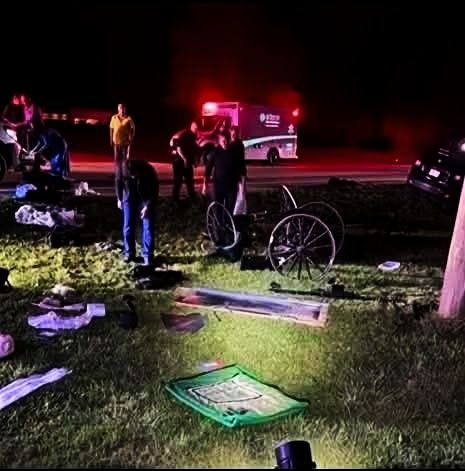
BERNE, Indiana — A late-night collision on State Road 218 turned a peaceful rural road into a chaotic emergency scene after a Jeep struck a horse-drawn Amish buggy, throwing nearly everyone out of the vehicle and sending multiple people to hospitals. First responders were called to the crash at about 11:20 p.m. on October 7; when they arrived they found a badly damaged buggy scattered across the pavement and a Jeep in a ditch.
The buggy was carrying nine people at the time of the crash. Local officials say a total of seven people from the buggy were injured and taken for medical care; reports describe six of those occupants as juveniles, though some local accounts list slightly different age breakdowns. The buggy’s driver, 32-year-old Ruben L.M. Schwartz of Berne, was airlifted to Lutheran Hospital. Joseph L.M. Schwartz, 20, and five juvenile passengers were transported by ambulance to Parkview Hospital. Two other passengers — Saraetta L. Schwartz, 32, and a 2-year-old — declined treatment at the scene.
Adams County Sheriff Dan Mawhorr told reporters the Jeep — driven by 33-year-old Bradley J. Ocilka of Burlington, Kentucky — struck the slower-moving buggy from behind while traveling eastbound on SR 218. Ocilka was taken to the hospital for a legal blood draw but declined other medical attention at the scene. At the time of reporting no charges had been filed while the crash remains under investigation.
A serious crash involving a horse-drawn buggy and a motor vehicle in rural Adams County underscores a persistent and often underestimated danger on American roadways: the coexistence of modern, high-speed traffic with traditional forms of transportation. Incidents like this are not just tragic accidents; they are reminders of the vulnerabilities faced by communities—such as the Amish—who rely on horse-drawn conveyances as part of their daily lives and cultural identity.
In this particular case, multiple emergency response agencies were dispatched, reflecting both the severity of the crash and the complexity of the scene. Emergency medical services, local police departments, fire personnel, and even an air medical transport team worked in coordination to provide immediate care to those injured and to secure the area. Witnesses and officials described the situation as chaotic, with debris scattered across the roadway and emergency lights illuminating the dark rural highway. These details paint a vivid picture of how quickly a quiet country road can turn into the site of a life-altering event.
The Amish community in Adams County is one of the largest Swiss-Amish settlements in the United States. Known for its close-knit structure, deep-rooted traditions, and reliance on horse-drawn buggies instead of motor vehicles, this community often travels the same roads as cars and trucks. When accidents occur, the impact is rarely limited to those directly involved; it ripples through families, neighbors, and the broader community. Emotional, social, and even economic consequences can be significant, particularly when injuries are severe or lives are lost.
One of the central issues highlighted by this crash is the inherent mismatch in speed and visibility between horse-drawn buggies and modern vehicles. Buggies typically travel at speeds of 5 to 10 miles per hour, while cars on rural highways may travel at speeds exceeding 50 miles per hour. This stark difference creates dangerous conditions, especially when drivers fail to anticipate slower-moving traffic ahead. At night, the risks are even greater. Although many buggies are equipped with reflective triangles, lanterns, or battery-powered lights, these measures may not always be sufficient for drivers who are distracted, fatigued, or simply unaccustomed to sharing the road with such vehicles.
Passing maneuvers are another major hazard. On narrow rural roads, drivers may attempt to pass a buggy without fully considering oncoming traffic, limited visibility, or the unpredictable behavior of the horse. Horses can become startled by loud engines, bright headlights, or sudden movements, potentially leading to loss of control. Even a slight miscalculation during a passing attempt can result in devastating consequences, as appears to have happened in this incident.
Safety experts consistently emphasize the importance of awareness and caution. Drivers are urged to slow down when approaching a buggy, maintain a safe following distance, and only pass when it is clearly safe to do so. Patience is critical; saving a few seconds is never worth risking lives. Additionally, motorists should be attentive to visual cues such as reflective markers, lanterns, and the distinctive silhouette of a buggy, particularly in low-light conditions.
From a broader perspective, there is also a need for ongoing dialogue between rural communities, transportation authorities, and policymakers. Some regions have implemented measures such as improved signage, designated buggy lanes, or public awareness campaigns aimed at educating drivers about sharing the road safely. Technological solutions, like enhanced reflective materials or better lighting systems for buggies, are also being explored, though they must be balanced with the cultural values and preferences of the Amish community.
Law enforcement agencies play a crucial role in both prevention and response. Regular patrols, enforcement of speed limits, and community outreach efforts can help reduce the likelihood of such accidents. Educational programs in schools and driver training courses can also raise awareness among younger drivers who may be less familiar with rural driving conditions.
Ultimately, this crash serves as a sobering reminder of the responsibilities that come with operating a vehicle. Roads are shared spaces, used by people with diverse lifestyles and modes of transportation. Respect, caution, and attentiveness are essential for ensuring everyone’s safety. For drivers traveling through rural areas, especially those known to have Amish populations, the message is clear: slow down, stay alert, and give horse-drawn buggies the space and consideration they need.
In the aftermath of such incidents, communities often come together to support those affected. The resilience and solidarity of close-knit groups like the Amish are well known, and local residents, leaders, and organizations will likely rally to provide assistance, whether through emotional support, financial help, or practical aid during recovery.
While no amount of reflection can undo the harm caused by a crash, each incident offers an opportunity to learn and to reinforce safer practices. By increasing awareness, promoting responsible driving behavior, and fostering mutual respect among all road users, it is possible to reduce the risk of future tragedies and to create safer environments for everyone who depends on these shared roadways.











Leave a Reply