
In a world where stories move fast and are forgotten even faster, there are some that refuse to fade—stories that cling to the heart, that demand to be felt, remembered, and shared. This is one of those stories.
It begins not with hope, but with loss.
On a cold, ordinary day that would soon become anything but ordinary, a tragic accident took the lives of two parents. In a matter of moments, a family was shattered. Two children were left behind—one barely old enough to understand what had happened, and the other suddenly forced to grow up overnight.
He was just 16.
At an age when most teenagers worry about exams, friendships, or what their future might look like, he was standing in a silent house, staring at the absence of everything he had ever known. The laughter was gone. The warmth was gone. The voices that once filled every corner of that home had disappeared forever.
But the silence didn’t last long.
Because in the next room, there was someone else.
His little sister.
She didn’t fully understand the gravity of their loss. She only knew that her parents weren’t coming back—and that her big brother was now the only person she had left in the world.
And in that moment, without ceremony or preparation, a 16-year-old boy became everything: a brother, a protector, a provider… a parent.
Grief had no time to settle. There were responsibilities now.
Every morning began before the sun rose. He would quietly get out of bed, careful not to wake his sister too early. In a small kitchen that once echoed with family breakfasts, he would prepare whatever food he could manage. Sometimes it was just bread. Sometimes tea. But he always made sure she ate.
He would help her get ready for school—fixing her hair the best he could, tying her shoes, making sure her backpack was packed. He learned things no one had ever taught him, simply because he had no choice.
Then he would walk her to school, holding her hand a little tighter than before.
And after that, his day would shift into something even harder.
Instead of sitting in a classroom, he went to work.
At a gas station on the edge of town, he spent long hours under the sun and the cold, filling tanks, cleaning windshields, and serving customers who often didn’t know the story behind his tired eyes. His hands, still young and uncalloused by life, quickly became rough from labor.
But he never complained.
Because every coin he earned had a purpose: his sister.
Food. Clothes. School supplies. Rent. Survival.
People began to notice him—not because he asked for attention, but because of his quiet determination. There was something different about him. Something heavier. Something deeper.
Customers would see him working tirelessly, day after day. Neighbors would watch him come home late, only to wake up early again. Teachers noticed his sister was always clean, always present, always trying.
Behind that effort was a boy refusing to let life destroy the only family he had left.
But life wasn’t finished testing him.
Authorities began to question whether a 16-year-old could legally and practically care for a young child. Concerns were raised. Papers were filed. And soon, what he feared most became reality.
The case went to court.
Suddenly, his love and sacrifice were not enough—they had to be proven.
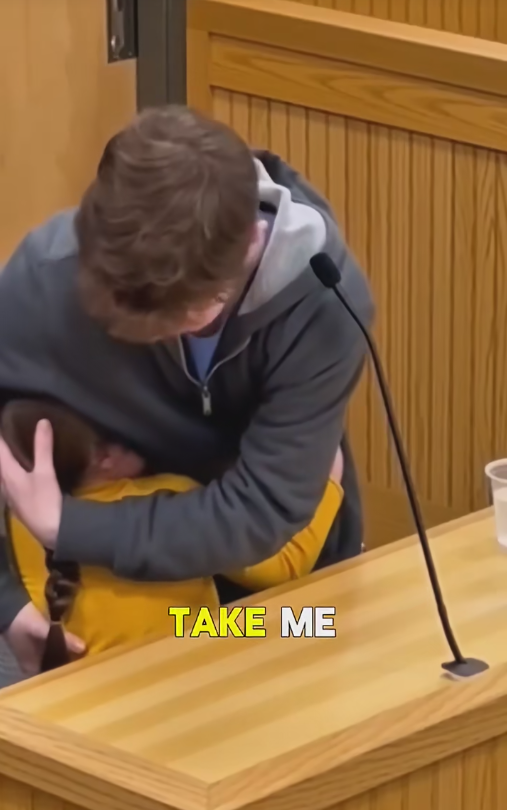
Inside the courtroom, everything felt different. Cold. Formal. Unforgiving. Words like “custody,” “guardianship,” and “capability” echoed through the space, each one carrying the weight of a decision that could separate him from his sister forever.
He sat there, nervous but determined.
He wasn’t afraid for himself.
He was afraid of losing her.
When it was his turn to speak, the room fell silent. This was not a trained speech. There were no prepared notes. Just a boy, standing in front of strangers, fighting for the only person he loved more than life itself.
His voice trembled at first, but his words were clear:
“I know I’m young. I know I don’t have everything. But she is my sister. She’s all I have. I wake up every day for her. I work for her. I try my best every single day so she doesn’t feel alone. Please… don’t take her away from me. I can’t lose her too.”
There wasn’t a dry eye in the room.
Witnesses were called. A neighbor spoke about how he had seen the boy share his last meal with his sister. A customer from the gas station described his work ethic and honesty. A teacher spoke about the little girl’s behavior—how she was cared for, how she still smiled, how she believed in her brother completely.
Piece by piece, the truth became undeniable.
This was not a child failing to cope.
This was a child rising beyond every expectation.
Outside the courtroom, his story had already begun to spread. People shared it online. Strangers offered support. Some wanted to help financially, others emotionally—but all were moved by the same thing:
His love.
Because in a world often filled with selfishness and indifference, this 16-year-old boy chose responsibility. He chose sacrifice. He chose to fight.
The day of the verdict arrived.
The tension was unbearable.
Every second felt like a lifetime as the judge prepared to speak. The boy held his sister’s hand tightly, as if letting go—even for a moment—might mean losing her forever.
And then, the decision came.
He was allowed to keep his sister.
With the support of social services and the community, the court recognized what truly mattered: not just age, not just circumstances—but love, commitment, and unwavering effort.
In that moment, everything changed.
He didn’t just win a legal case.
He won the right to remain a family.
Today, his life is still far from easy. He continues to work at the gas station. He continues to wake up early, to struggle, to sacrifice. But now, he is no longer invisible.
His story has reached thousands. Maybe millions.
And more importantly, his sister still has her home.
Every night, after long hours of work, he returns to that small house. It’s still quiet. It still carries the echoes of loss. But now, there is something else too.
Hope.
When his sister runs to him with a smile, when she tells him about her day, when she laughs—that is his victory.
Not the court.
Not the attention.
But the simple, powerful truth that they are still together.
Because sometimes, heroes don’t wear capes.
Sometimes, they wear worn-out shoes, smell like gasoline, and carry the weight of the world on their shoulders—without ever giving up.
And sometimes, they are only 16 years old.










Leave a Reply