
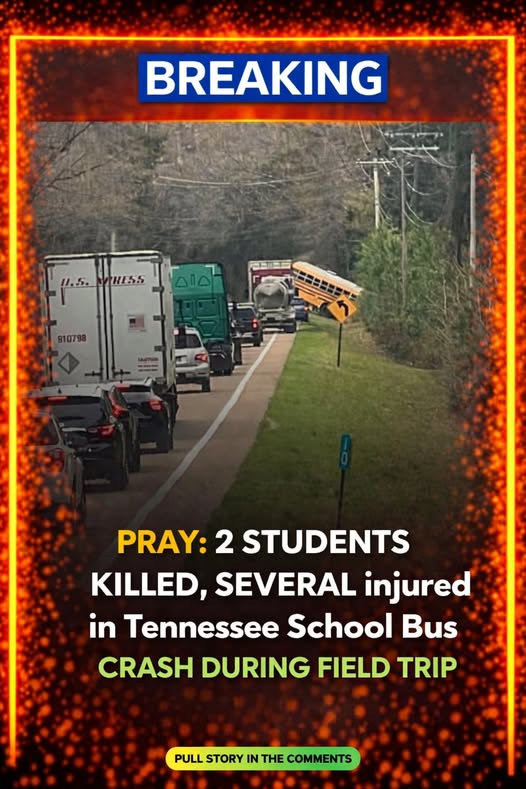
The morning of March 28, 2026, began with the kind of infectious excitement only a middle school field trip can generate. Students from Kenwood Middle School were headed to a GreenpowerUSA event, an opportunity designed to spark innovation, teamwork, and a passion for engineering. They were supposed to spend the day chasing ideas and building the future. Instead, that bright promise was shattered in an instant of twisted metal and shattered glass on Highway 70. What was meant to be a milestone of middle school life has instead become a site of unimaginable grief, as two students were killed at the scene and several others were left fighting for their lives in hospitals across Tennessee.
The chaotic aftermath on the highway saw a massive mobilization of emergency resources. LifeFlight helicopters and a fleet of ambulances rushed to the wreckage, transporting the injured to specialized trauma centers. Among those in the most precarious condition is the bus driver, who remains in critical care as medical teams work around the clock. As investigators begin the somber task of reconstructing the final seconds before the impact, the physical scars on the pavement serve as a haunting reminder of how quickly a routine journey can turn into a catastrophe.
The shockwaves of this devastating accident have rippled far beyond the immediate scene, leaving a profound and lasting impact on the communities of Carroll and Montgomery counties. In places where everyone knows each other—where neighbors are more like extended family—this tragedy is not something distant or abstract. It is deeply personal. It has settled into the fabric of daily life, turning ordinary routines into painful reminders of what has been lost. It is felt in every quiet street, every school hallway, and most heartbreakingly, at every kitchen table where families now sit with a grief that words cannot fully capture.
In these close-knit communities, the weight of the tragedy is shared collectively. Conversations that once revolved around everyday life—school events, weekend plans, small victories—are now overshadowed by sorrow and disbelief. Parents find themselves trapped in cycles of agonizing reflection, replaying the smallest details of that morning over and over again. The seemingly insignificant moments—rushed breakfasts, forgotten lunches, quick hugs at the door—have taken on an unbearable significance. The casual “goodbye” or “see you later” now echoes with a painful finality that no one could have anticipated. For some families, those ordinary words became the last connection they would ever have with their child.
As the days pass, that initial shock begins to give way to a deeper, more complex grief. It is no longer just disbelief—it becomes a heavy presence that follows people everywhere. Simple tasks feel harder. Silence feels louder. Even moments that should bring comfort are tinged with an ache that cannot be ignored. For many parents, sleep becomes difficult, haunted by memories and unanswered questions. Mornings, once filled with routine and purpose, now begin with a quiet heaviness that is impossible to shake.
The grief is not confined to individual households; it has become a shared emotional landscape. Community members lean on one another, yet even collective support struggles to ease the depth of the loss. There is a sense of disbelief that lingers, as if the mind refuses to fully accept what the heart already knows. People gather not because they have answers, but because they cannot bear to face the silence alone. Vigils are held, candles are lit, and names are spoken softly into the night—small acts of remembrance that attempt to bring light into an otherwise overwhelming darkness.
At local gathering places—churches, community centers, and school grounds—there is a quiet understanding that no one should have to carry this pain alone. Yet even in these shared spaces, the grief remains deeply individual. Each family, each parent, each child processes the loss in their own way. Some speak openly, finding solace in sharing memories. Others retreat inward, holding their pain in silence. There is no right way to grieve, only the slow and uncertain process of learning how to live with what has happened.
At Kenwood Middle School, the tragedy has taken on an especially haunting presence. The building that once echoed with laughter, chatter, and the restless energy of youth is now filled with a heavy, suffocating stillness. Classrooms, once vibrant and alive, are now marked by absence. Empty desks stand as silent reminders of lives interrupted, dreams unfinished, and futures that will never unfold. Backpacks left behind, notes scribbled in notebooks, and unfinished assignments have suddenly become artifacts of a moment frozen in time.
For teachers, returning to this environment is nothing short of heartbreaking. Every corner of the school holds a memory. Every hallway carries an echo of what once was. The familiar has become unfamiliar, reshaped by loss. Educators now face a challenge that goes far beyond lesson plans and curriculum. They are being asked to guide their students through a reality that even adults struggle to comprehend.
How does one explain the unexplainable? How do you provide comfort when there are no adequate words? Teachers, who are often pillars of strength and stability, must now navigate their own grief while trying to support children who are experiencing loss, confusion, and fear—many for the first time in their lives. They must strike a delicate balance between honesty and protection, acknowledging the pain without overwhelming young minds that are still trying to make sense of the world.
In these classrooms, emotions are raw and unpredictable. Some students may sit in silence, unable to process what has happened. Others may ask difficult questions, searching for meaning in a situation that offers none. There are tears that come without warning, moments of laughter quickly followed by guilt, and an overwhelming sense of vulnerability that lingers beneath the surface. Even the smallest triggers—a familiar name, an empty chair, a shared memory—can reopen wounds that have barely begun to heal.
The role of a teacher has shifted from educator to counselor, from instructor to emotional anchor. Lessons are no longer just academic; they are moments of human connection, opportunities to reassure, to listen, and simply to be present. In many ways, the classroom has become a space not just for learning, but for collective healing.
The impact of this tragedy extends beyond the school and into the broader community. Local sports teams play with heavy hearts. Neighborhood streets feel quieter. Even celebrations and gatherings carry an undercurrent of sadness, as if something essential is missing. The absence is not always visible, but it is always felt.
Over time, the sharp edges of grief may soften, but they will never fully disappear. Anniversaries will bring the pain back to the surface. Milestones—graduations, birthdays, life events—will be marked not only by who is present, but by who is not. The loss becomes a part of the community’s identity, something carried forward in memory and in spirit.
Yet within this profound sorrow, there is also a quiet resilience. Communities like Carroll and Montgomery counties are built on connection, compassion, and shared strength. In the face of unimaginable loss, people begin to show up for one another in ways both big and small. Meals are shared. Stories are told. Support is offered not just in words, but in presence.
This resilience does not erase the pain, but it provides a path forward. It reminds those affected that even in the darkest moments, they are not alone. Slowly, and often unevenly, life begins to move again. Laughter returns in brief, unexpected moments. Hope, though fragile, starts to reappear.
They will remember. They will mourn. And in time, they will rebuild—not by forgetting what was lost, but by carrying it with them. In the way they speak the names of those gone, in the way they care for one another, and in the way they choose to keep going despite the weight they bear, the memory of this tragedy will endure. Not only as a moment of loss, but as a testament to the strength of a community that refused to break.










Leave a Reply